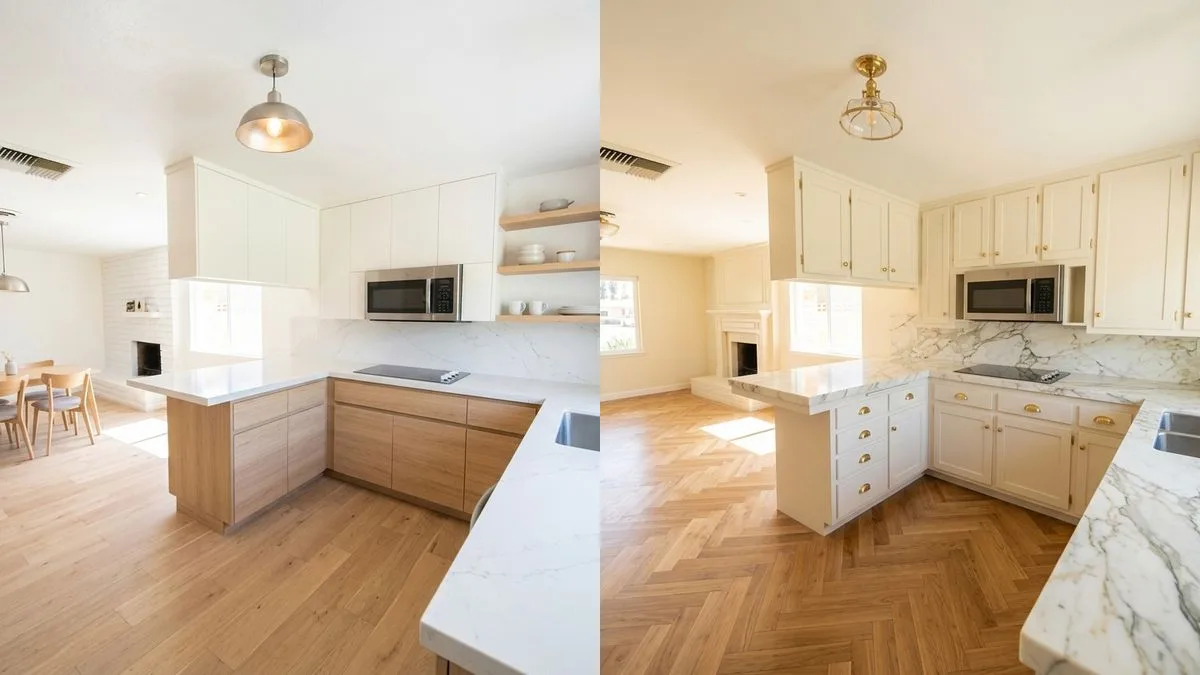
 Kitchen AI


 Modern
 Scandinavian
 Japandi
 Modern farmhouse
 Industrial
 Quiet luxury
- Color decisions
- Off-white cabinets
- Trend watch
Are Off-White Kitchen Cabinets Still in Style?
Off-white cabinets are still one of the more common colors in new kitchens, but for a different reason than white cabinets are. We ran the same dated kitchen through five finishes in Kitchen AI to see where off-white still holds up, where it reads dated, and what's already taking its place for 2027.

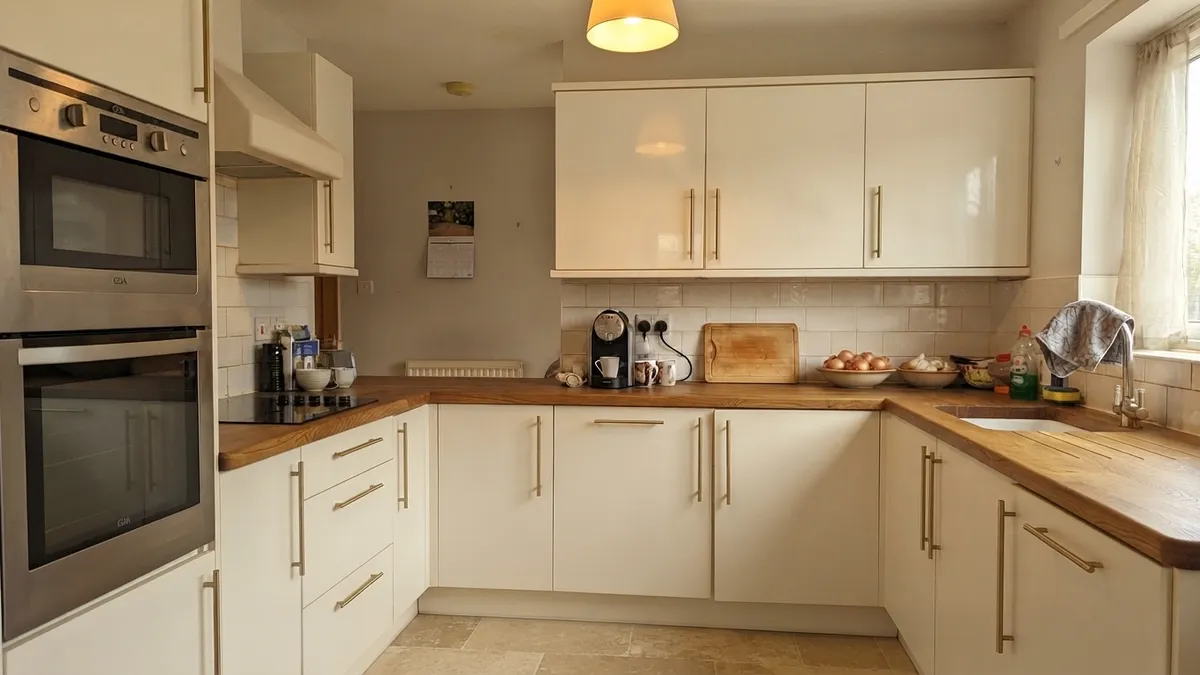
The same dated kitchen redone in off-white shaker cabinets, with a warm oak countertop and brass hardware in place of the original high-gloss cream and dark speckled counter.
Free to try. No account needed.
Yes, off-white kitchen cabinets are still in style, though not for the same reason white cabinets are. According to the Houzz Kitchen Trends Study, wood-tone cabinet fronts now lead all kitchen renovations at 29%, plain white follows close behind at 28%, and off-white holds a steady 15%. White's share has been sliding year over year. Off-white's has not. The two colors look almost identical on a paint chip and are moving in opposite directions in real kitchens, and the reason comes down to undertone: off-white already sits on the warm side of the color wheel, which happens to be exactly where kitchen trends are heading next.
We ran the same dated kitchen, a U-shaped layout with high-gloss cream slab fronts, a dark speckled countertop, and cream metro tile, through five cabinet finishes in Kitchen AI: an off-white shaker with warm oak and brass, a two-tone sage green, a full warm-oak wood front, a cool graphite, and a navy blue that kept the original tile and floor untouched. Comparing them side by side in the same room, with the same light and layout, made the difference between "still current" and "reads dated" a lot more specific than a paint swatch ever does.
What the numbers actually say
The Houzz Kitchen Trends Study puts real figures behind what otherwise sounds like an opinion. Wood-tone fronts lead all kitchen renovations, off-white and plain white together still account for close to half of all renovations combined, and the detail worth paying attention to is the direction each color is moving, not just its current share.
| Cabinet color | Share of renovations | Direction |
|---|---|---|
| Wood tone | 29% | Leading category |
| White | 28% | Declining year over year |
| Off-white | 15% | Stable year over year |
Fifteen percent is not a small number for a single color family; it's roughly one in seven kitchens. What matters more for anyone specifically worried about off-white is that this share has held rather than eroded while white's has not. Two colors close enough to be confused in a showroom are not behaving the same way in real renovation decisions.
Why off-white keeps its footing while white slips
Plain white is a neutral with nowhere to go. It doesn't lean warm or cool, so when a trend moves toward warmer tones, as the forecasts below already are, a stark white has nothing in common with where the room is heading and starts to look like it belongs to a different kitchen than the one around it. Off-white was never fully neutral to begin with. A cream, ivory, or warm base already sits closer to wood tones, terracotta, and sage green than a true white ever does.
That's the mechanism behind the Houzz numbers, not a coincidence. Off-white isn't outperforming white because it's more fashionable in the abstract. It's holding its share because it started closer to where the rest of the kitchen, and the rest of the industry, is already moving. As the room warms up around it, off-white travels part of that distance for free, without the cabinet color itself having to change.
That also explains why the same forecast doesn't spell trouble for off-white the way it does for white. A designer swapping a stark white for a warmer palette is changing the cabinet color outright. A designer working from an existing off-white can often leave the cabinets alone and let the countertop, the backsplash, or the hardware carry the rest of the warmth, which is a smaller, cheaper move than repainting or replacing the fronts. Which countertop does that for a cream or warm white front is the subject of best countertop colors for white cabinets.
Where off-white still reads dated
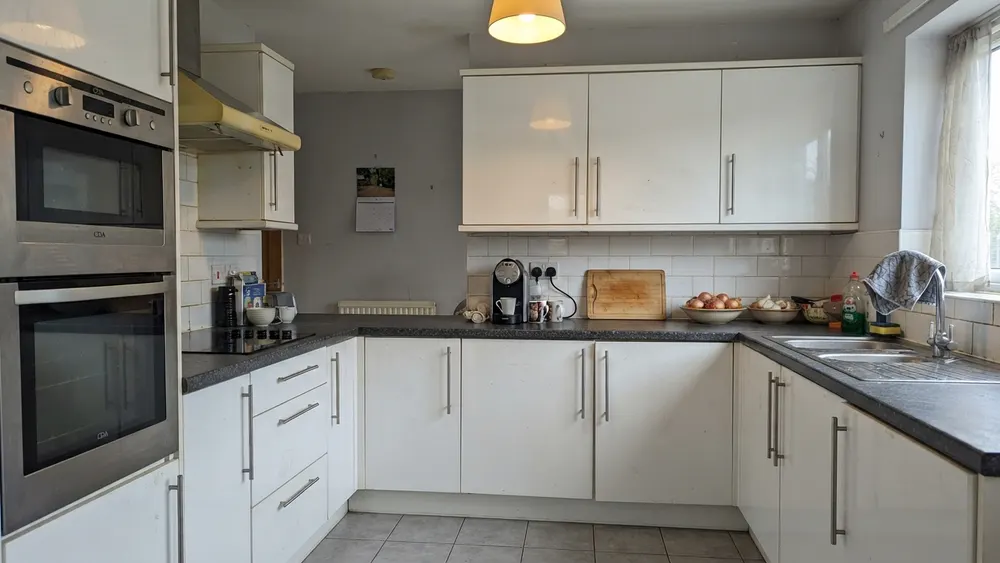
Off-white doesn't date because of the color family. It dates because of two choices that usually get layered on top of it. The first is a high-gloss finish. Gloss reflects everything around it, including the age of whatever's next to it, so a slab-front gloss door from a previous decade reads instantly as a previous-decade kitchen no matter how warm the base color technically is. The second is a cool undertone, an off-white leaning toward gray rather than cream, sometimes sold as "greige," which fights the warm materials the room is moving toward instead of joining them.
The kitchen above is a clear example. None of its individual materials are unusual or wrong on their own; the gloss finish and the cool, flecked countertop are what pull the room toward the specific combination that reads dated, independent of the fact that the cabinet color itself is a warm cream and technically on-trend.
What's replacing all-white kitchens for 2027
The paint industry's color-of-the-year picks for 2027 point in the same direction as the Houzz numbers. Dulux named Soulful Sage, a muted green, its color of the year for 2027. Behr picked Grounded, a mossy green. Valspar chose Cottage Door, a mid-tone blue. Dutch Boy went with Deep Rooted, an earthy orange. Four different paint companies, four different colors, and not one of them is a white or an off-white. Designers surveyed alongside these picks describe the same shift in different words: more green, more visible warm wood grain, more terracotta and clay, and a growing sense that an entirely white kitchen is starting to feel dated rather than safe.
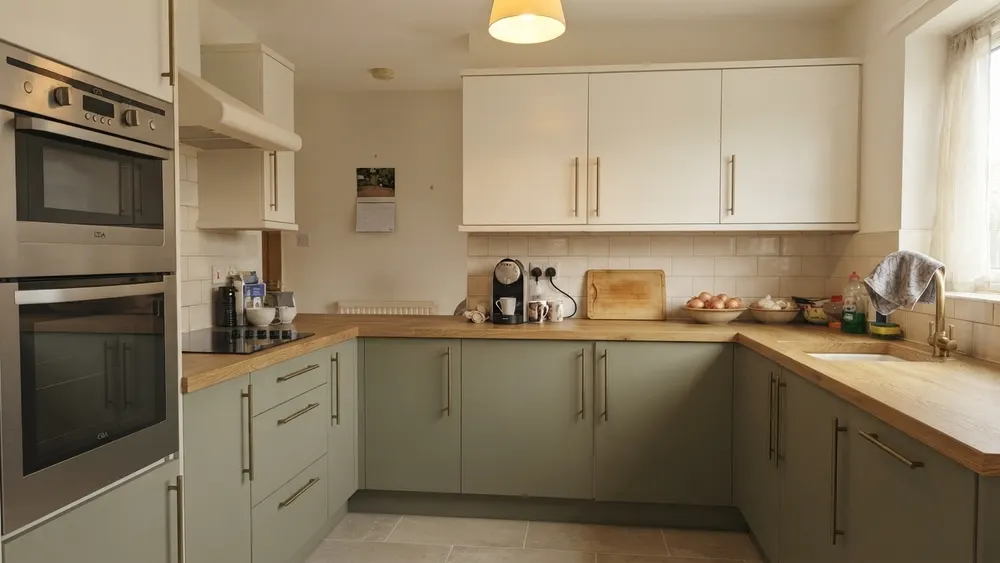
One way to test that shift without committing to a full repaint is to keep off-white where it already works, on the upper cabinets, and bring one of the incoming colors onto the lower run instead, as in the render above. The tile backsplash didn't need to change for the room to read differently.
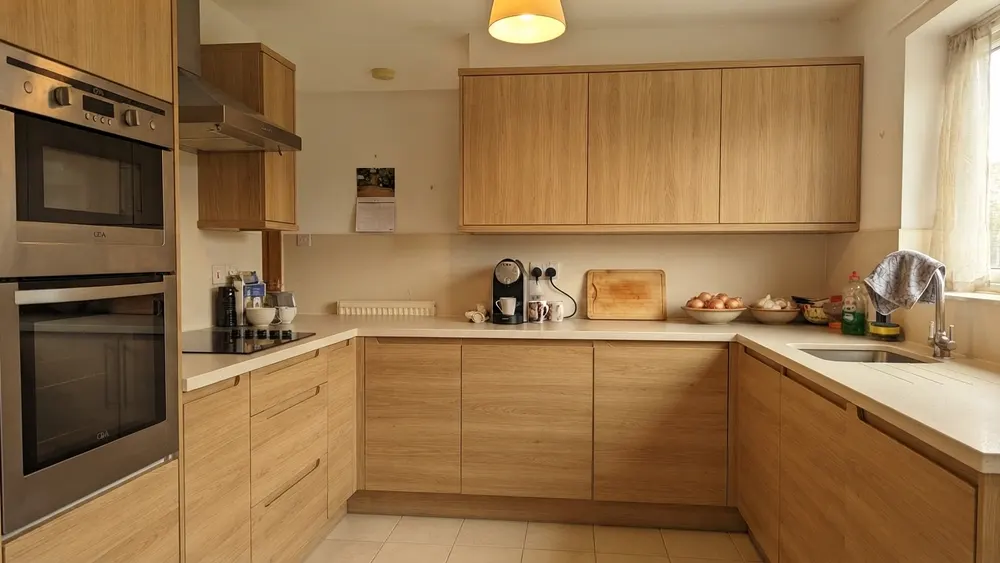
Wood tone is the other, larger beneficiary, and it isn't hypothetical: it's already the single biggest cabinet category in the Houzz data, just ahead of white and off-white. The render above drops the same layout into warm oak slab fronts instead of any painted finish at all. There's no white or off-white cabinet color in it; the wood grain does the work a paint color usually does.
Choosing off-white so it still works in five years
None of this means off-white is finished. It means the version that lasts is more specific than "pick any warm-sounding white." Three choices do most of the work. Undertone: choose a cream or ivory base rather than a gray-leaning greige, since gray pulls toward the cool end that's declining, not the warm end that's holding. Finish: a matte or satin door reads current in a way a gloss door doesn't, regardless of the color underneath. Hardware: brass, warm brushed brass, or aged bronze carry the warmth through the rest of the room, where plain chrome or bright nickel can undercut it.
If you want a concrete starting point rather than a mood board, Benjamin Moore White Dove, Sherwin-Williams Alabaster, and Behr Swiss Coffee are the three off-white shades that keep showing up in 2026 kitchen specifications, and all three lean warm rather than gray.
If you haven't settled the more basic question yet, a true white or an off-white in the first place, white vs. off-white kitchen cabinets covers that decision on its own: which one suits your light, your floor, and your existing hardware, before you get as far as picking a specific shade. An oak or other warm-toned floor tends to make the warm-undertone choice easier, since the two reinforce each other instead of fighting; see kitchen cabinet colors that work with oak floors for how six different cabinet colors, not just white ones, read against that same kind of warm floor.
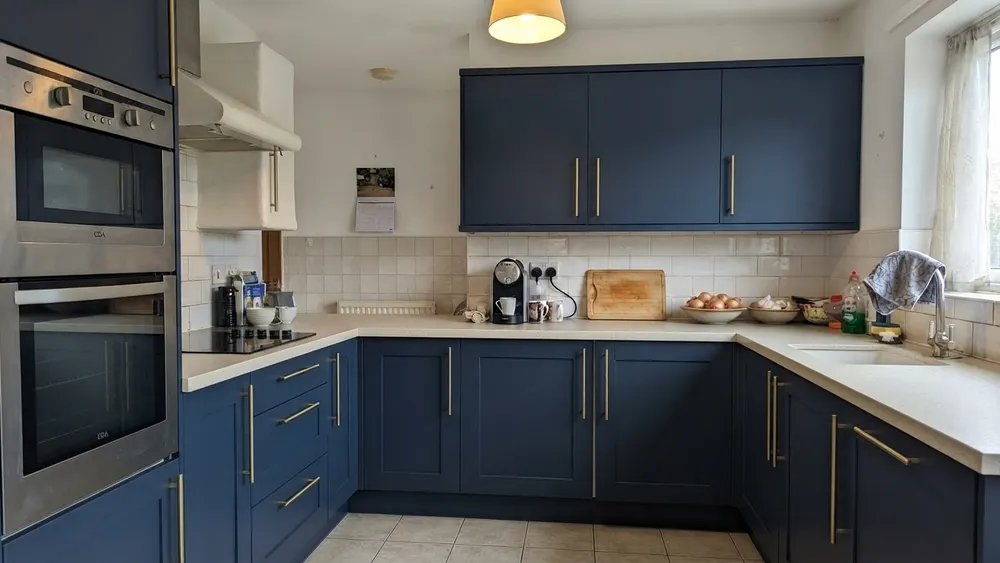
You don't need a full remodel to see whether off-white is even the right lane for you. In the render above, the cabinet fronts moved to a saturated navy while the tile and floor stayed untouched, which is a useful way to see how far a room can shift on cabinet color alone before deciding whether off-white, or something else entirely, is the direction worth committing to. If off-white paired with warm wood is the general direction you're after rather than one specific paint shade, the modern farmhouse kitchen style guide covers the fuller material palette that usually goes with it.
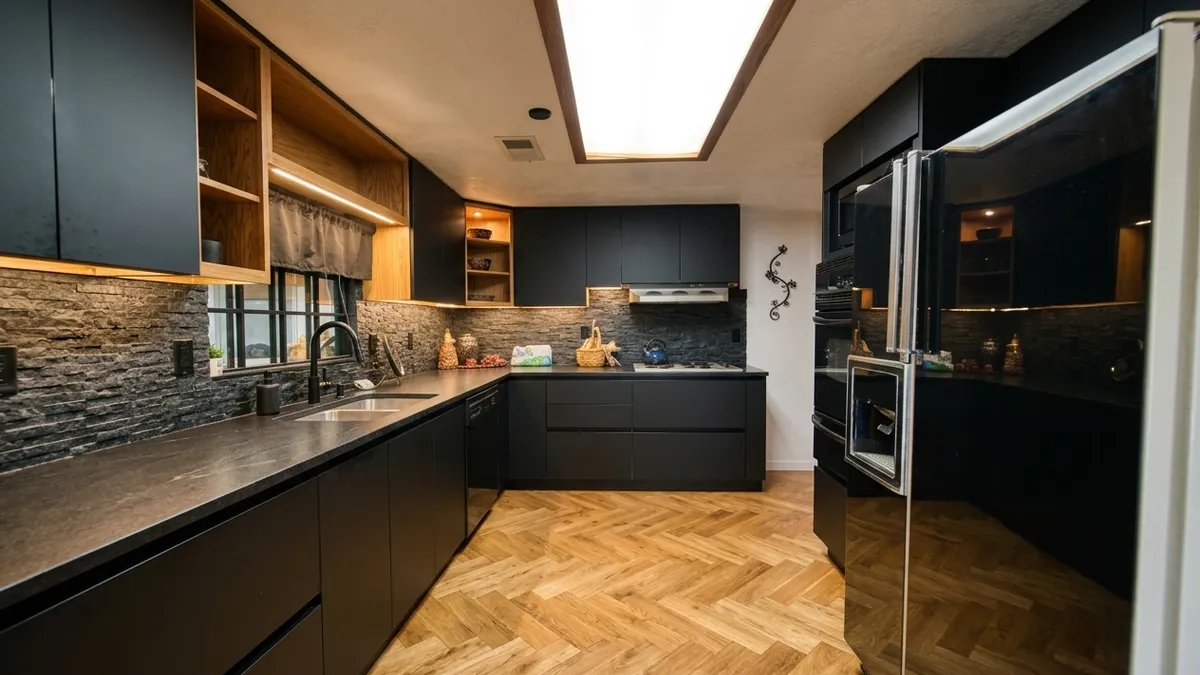
Off-white isn't the only lane, either. A cooler, handleless graphite finish, paired here with a marble-look countertop and matching backsplash, points in the opposite direction entirely, toward a quieter, more monochrome kitchen than the warm trend described above. It's a legitimate choice. It's just a different question than the one this article is answering.
What the app can't do
The app can't tell you whether your specific choice of off-white will still look current in five years. That's a design judgment, not something a photo render settles for you. What it can do is show you how a particular off-white behaves in your own kitchen's actual light, against your own floor and hardware, in a matte or satin finish, today, so you're deciding from a realistic picture instead of a paint chip under store lighting. It doesn't give you a paint code or a manufacturer's product name; it works from a photo and shows you a material, not a swatch you can hand to a contractor. It doesn't move cabinets, walls, or windows either. Your kitchen's layout stays exactly as you photographed it.
Frequently asked questions
Are off-white kitchen cabinets outdated in 2026?
No, not as a color family. The Houzz Kitchen Trends Study puts off-white at a stable 15% share of renovations while plain white's share has been declining. A gloss finish or a gray-leaning off-white can still look dated; a matte, cream-based one generally doesn't.
What color is replacing white kitchen cabinets?
No single color is, but the direction is consistent. Wood tone already leads the Houzz renovation data at 29%, and the paint industry's 2027 color-of-the-year picks (Dulux Soulful Sage, Behr Grounded, Valspar Cottage Door, Dutch Boy Deep Rooted) all move toward green, blue, or earthy tones rather than white.
Is off-white the same as cream or ivory cabinets?
They describe the same idea: a white with a second color mixed into the base. What matters is which second color. A cream or ivory leans yellow and warm. A greige leans gray and cool, and behaves more like the dated combination described above than like a typical off-white.
Does the finish matter more than the color itself?
For how dated a kitchen looks, often yes. The gloss-finish kitchen shown earlier in this article is technically an off-white, the same color family the Houzz data says is holding steady, and it still reads as a previous-decade kitchen. Undertone decides which direction a color is moving; finish decides how quickly it shows its age.
Will off-white cabinets hurt my home's resale value?
The Houzz renovation share doesn't measure resale value directly, but a widely used color like off-white, at 15% of remodels, is a safer bet for a broad range of buyers than a niche one. Finish and hardware matter as much as the base color for how current the kitchen reads.
See it in your own kitchen before you commit
A trend forecast is a probability, not a certainty for your kitchen specifically. Your own undertone, floor, and hardware decide more than any paint company's color of the year does. Photograph your kitchen, try a warm off-white against your own floor and fixtures, and see whether it agrees with the room before you commit to it for the next decade.
Published September 20, 2026. The images in this article were made with Kitchen AI and are an AI impression, not a technical drawing. How we mark that.
I build Kitchen AI on my own: the app that shows your own kitchen in a different style. For these articles I test everything in real rooms, with real photos, and write down what happens. Something wrong, or missing? Let me know.