 Kitchen AI

- Color decisions
- Flooring
- See it first
Should Kitchen Cabinets Match the Floor?
Not exactly, and designers are fairly unanimous about it. Cabinets and floors are meant to complement each other through contrast or undertone, not repeat the same color. We put three different cabinet-and-floor pairings, from close match to full contrast, in the same island kitchen so you can see where the line actually is.

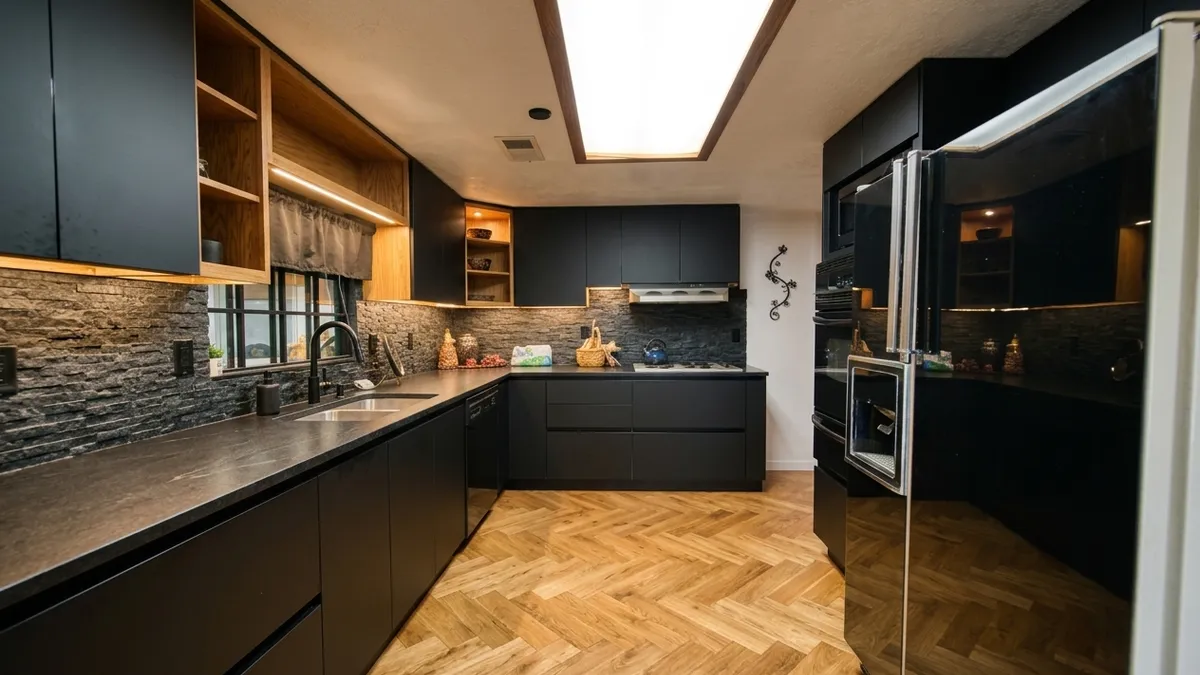
Black cabinets over a dark herringbone floor: two dark surfaces that read as one confident block of color instead of clashing, because the wood tones underneath still differ.
Free to try. No account needed.
No, kitchen cabinets and flooring generally shouldn't match exactly. Designers consistently recommend complementary colors over an identical match: a common rule of thumb pairs darker cabinets with a lighter floor, or the reverse, so the two surfaces read as separate, intentional choices rather than one color bleeding into another. An identical match, especially in the same wood tone, tends to flatten the room instead of grounding it. The three pairings below show what changes when you move from a close match toward full contrast in the same kitchen.
Most "match your floor to your cabinets" guides give you a single fixed rule and one glossy photo to prove it. Kitchens vary more than that. We photographed one dated kitchen with a wood-clad island and ran three different cabinet colors through it, on three different floors, to see where a close match still works and where it visibly doesn't.
Match or contrast: what actually works
Kitchen flooring and cabinets are meant to complement each other, not mirror each other, according to the general consensus among kitchen and flooring designers. The most common version of the rule of thumb: pair darker cabinets with a lighter floor, or lighter cabinets with a darker floor, unless you're deliberately going for a moody, tonal look where everything sits close in value on purpose. Carolina Hansson, head of design at Luxury Flooring and Furnishings, put it plainly in an interview with Livingetc: "Use contrast to create balance and visual appeal by choosing two dominant colors and a minor accent color in the opposite tone." The combination designers warn against most consistently isn't a close match, it's an identical one: the same wood species, stain and sheen on both the cabinets and the floor, which tends to remove the visual break between the two surfaces entirely.
One kitchen, three cabinet-and-floor pairings
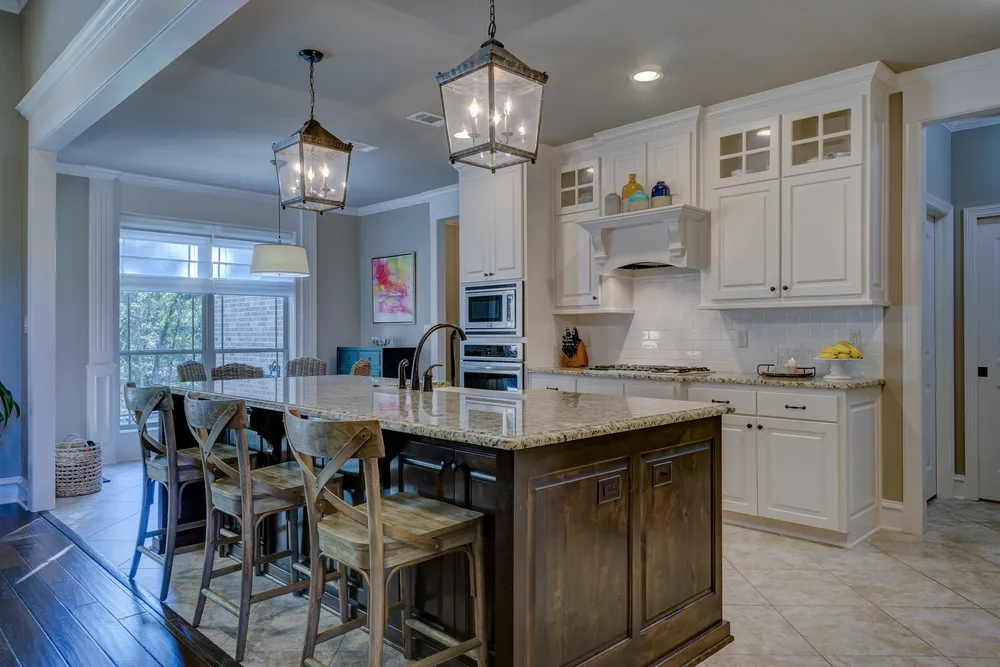
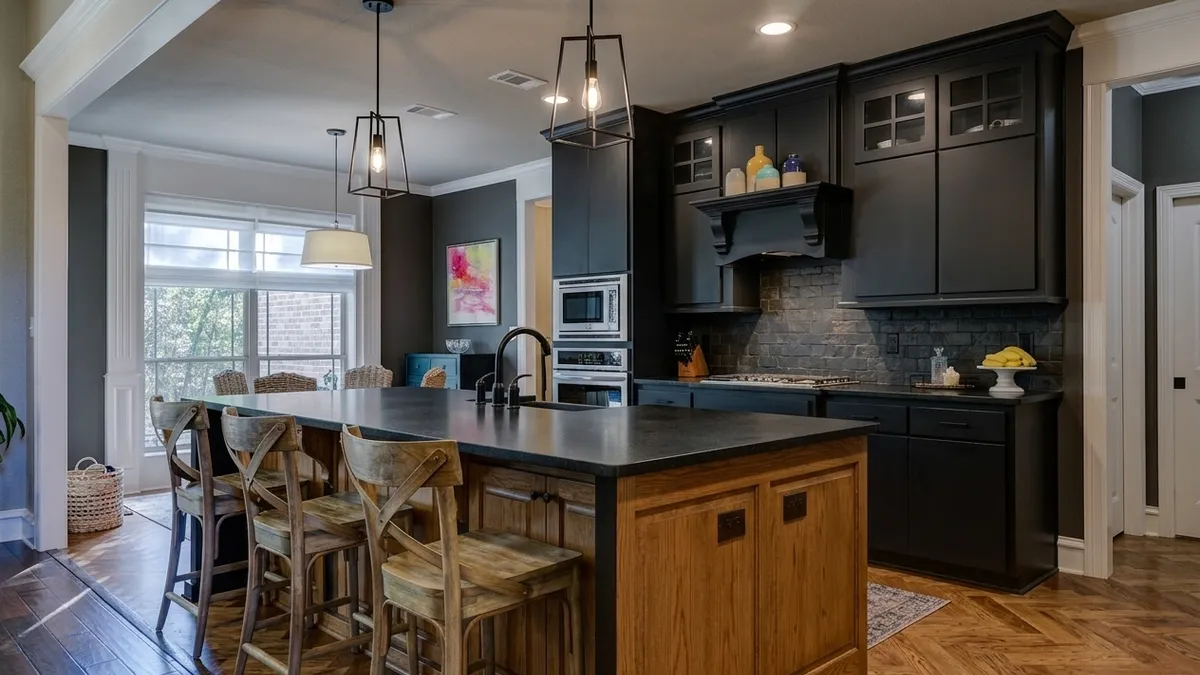
This is one island kitchen, run through three cabinet-and-floor combinations while the layout, the island, and the three pendant lights stayed exactly the same. We rejected a fourth variant, a green cabinet on the same warm floor as the cream version below, because it duplicated a pairing we'd already shown in a different kitchen; these three cover close match, moderate contrast, and full contrast without repeating that ground.
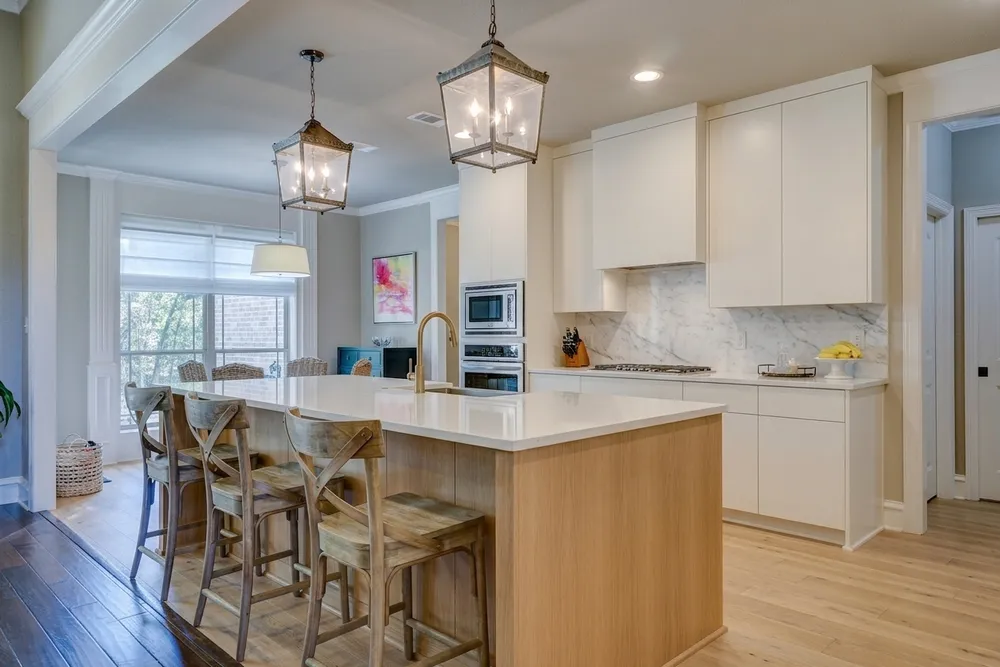
Here the cream cabinet and the oak floor share the same warm undertone, but the cabinet is light enough and the floor saturated enough that they still read as two distinct surfaces rather than one continuous color. This is the middle ground most kitchens actually land in: not a stark contrast, not a match, just enough separation in value to keep the eye moving between the two.
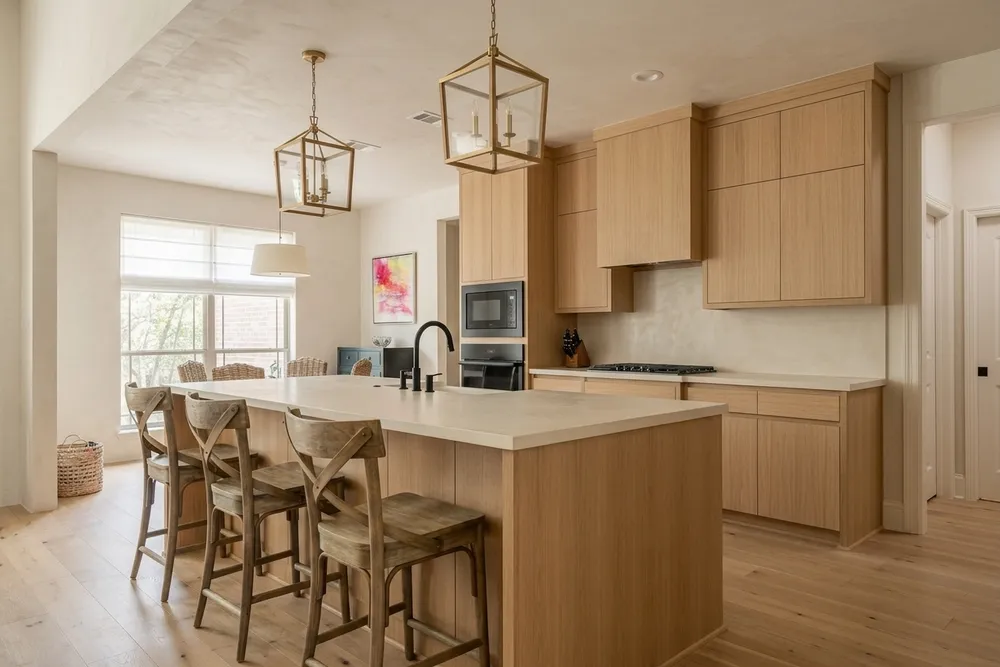
This is the pairing people worry about most, wood cabinets on a wood floor in a similar tone, and it's also the one that works more often than the warnings suggest, as long as the two aren't cut from the same board. Here the cabinet grain runs vertically and the finish is slightly warmer than the floor, which is just enough separation to read as "a light, cohesive kitchen" instead of "the cabinets disappearing into the floor." The hero photo at the top of this article shows the opposite end of the same room: black cabinets and a walnut island over a dark herringbone floor, where the contrast is deliberate and the two dark tones still read as separate because the wood grain and the paint finish behave differently under light.
Undertone matters more than the color name
"Wood floor" and "wood cabinet" aren't specific enough to predict whether a pairing will work, the same way "white" isn't specific enough to predict whether two white paints will agree with each other. A honey-toned oak floor with strong orange and red undertones limits which cabinet colors will sit comfortably above it more than a pale, gray-washed oak does, because two warm, similarly saturated tones can compete instead of blending. A cooler cabinet color, or a warm one at a clearly different value from the floor, tends to hold up more reliably against a strongly colored floor than a similarly warm, similarly light one does.
The same logic applies past wood. A tile or luxury vinyl plank floor in a cool gray reads closer to a "neutral" backdrop than any wood floor does, since it has less of its own undertone to clash or blend with; a patterned tile floor, on the other hand, behaves more like the herringbone wood above, adding visual noise under a high-contrast cabinet color and calming down under a cabinet closer to its own tone. Whatever the material, look at undertone and pattern first and the specific product name second.
Should the floor be lighter or darker than the cabinets?
Either can work, and there's no single correct order between them. The stronger pattern designers point to is that a naturally bright kitchen, with more windows or south-facing light, can carry a darker floor or darker cabinets without feeling closed in, while a dimmer kitchen benefits from staying lighter on at least one of the two surfaces. Room size matters in the same direction: a small, enclosed kitchen with dark cabinets and a dark floor together removes almost every light-reflecting surface in the room at once, which is the actual risk, more than which one of the two is darker.
If you're also deciding on the cabinet color itself before you get to the floor, undertone against a specific floor type, particularly oak, gets its own detailed breakdown with six color options in kitchen cabinet colors that work with oak floors, and the white-versus-off-white side of the same undertone question is in white vs. off-white kitchen cabinets. Both cover the same undertone logic used here, applied to a different starting question.
What the app can't do
The app can't tell you whether your actual floor is solid wood, engineered wood, tile, or a look-alike vinyl plank; it works from the photo, and some materials look nearly identical in a render even though they perform very differently underfoot. It doesn't recommend a specific product or SKU for either the cabinet or the floor, doesn't estimate cost, and doesn't move cabinets, islands, or walls: the room's layout stays exactly as you photographed it. Every result is an AI impression of how two tones sit together in your space, not a flooring sample or paint chip you can hold up to a shelf swatch, so confirm the real materials under your own lighting before you order either one.
Frequently asked questions
Is it ever fine for cabinets and the floor to be nearly the same color?
Yes, if you want a deliberately calm, tonal room and the two surfaces still differ enough in texture, sheen, or grain direction to read as separate materials rather than one continuous surface. The risk is a floor and cabinet in the exact same wood species, stain, and finish, which tends to flatten the room rather than ground it.
Should the countertop match the cabinets or the floor instead?
Neither, usually. A countertop that sits close in tone to both the cabinets and the floor tends to disappear into the room; one that contrasts with at least one of the two gives the eye a clear break between surfaces, the same principle used for the cabinet-to-floor decision itself.
Does a small kitchen need a lighter floor no matter what?
Not strictly, but a small, enclosed kitchen with both dark cabinets and a dark floor removes most of the room's light-reflecting surfaces at once, which tends to read as smaller and dimmer. Keeping the countertop or backsplash light is often enough to avoid that even if the floor stays dark.
Test your own cabinets against your own floor
A single showroom photo won't tell you whether your specific floor and a new cabinet color will agree once they're both under your own lighting. Photograph your kitchen, leave the floor as it is, and try a cabinet color next to it before you order samples of either.
Published September 8, 2026. The images in this article were made with Kitchen AI and are an AI impression, not a technical drawing. How we mark that.
I build Kitchen AI on my own: the app that shows your own kitchen in a different style. For these articles I test everything in real rooms, with real photos, and write down what happens. Something wrong, or missing? Let me know.