- Door styles
- Glass uppers
- See it first
Glass Front Kitchen Cabinets: A Good Idea?
Glass doors on the uppers make the wall lighter and turn it into display space, but they show everything inside. One dated kitchen, in solid white, white glass and sage glass, and what decides it.

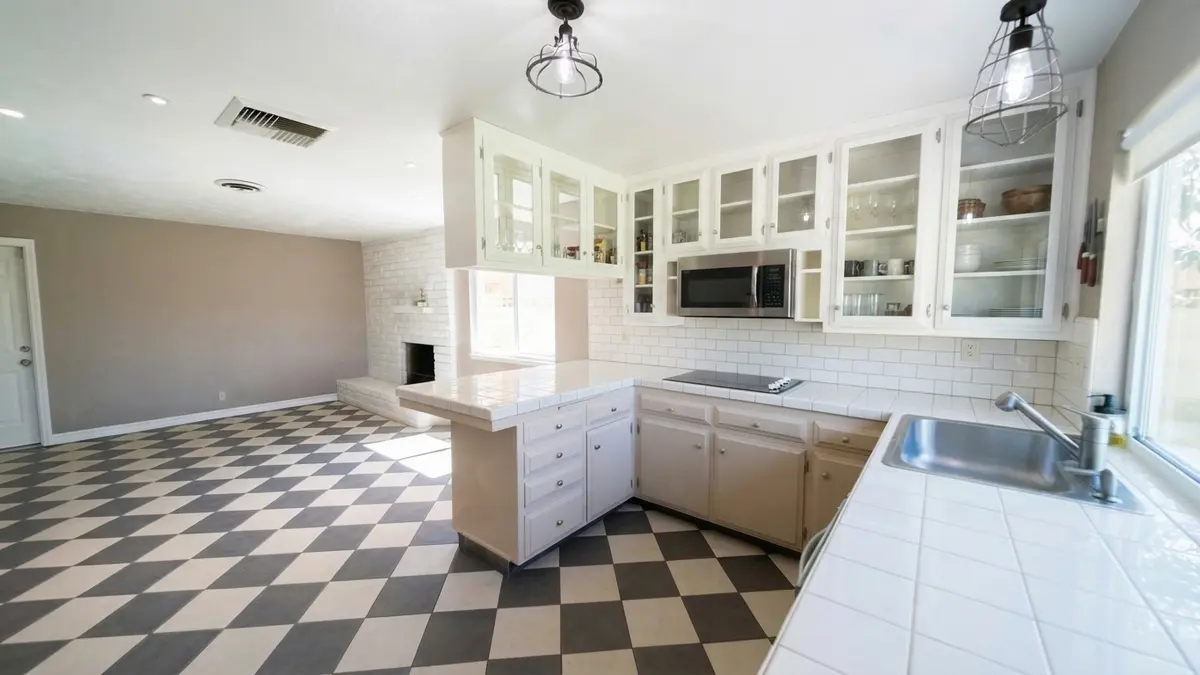
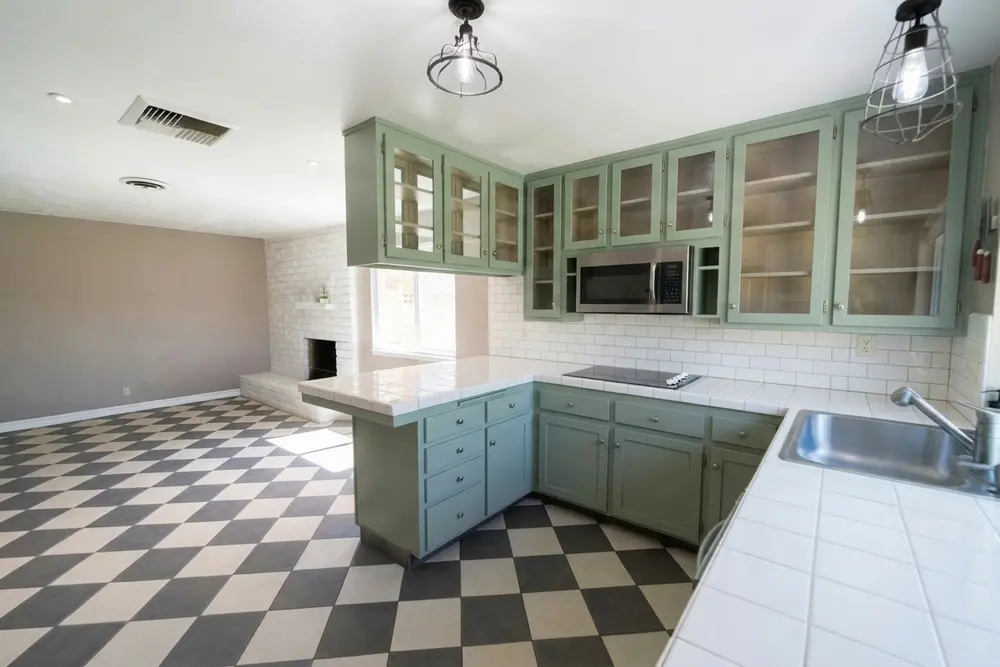
The kitchen after the Glass uppers door style. Every upper door is now framed clear glass and the app stocked the shelves with glassware, mugs and plates; the base cabinets, countertop, backsplash, floor and appliances did not change.
3 free designs. No account needed.
Glass upper cabinets make the upper wall look lighter and turn it into display space. The price is that the doors show whatever is inside, and there is more glass to wipe. Seeing glass on your own kitchen first is the honest test, because the question is less about the door than about what you would put behind it.
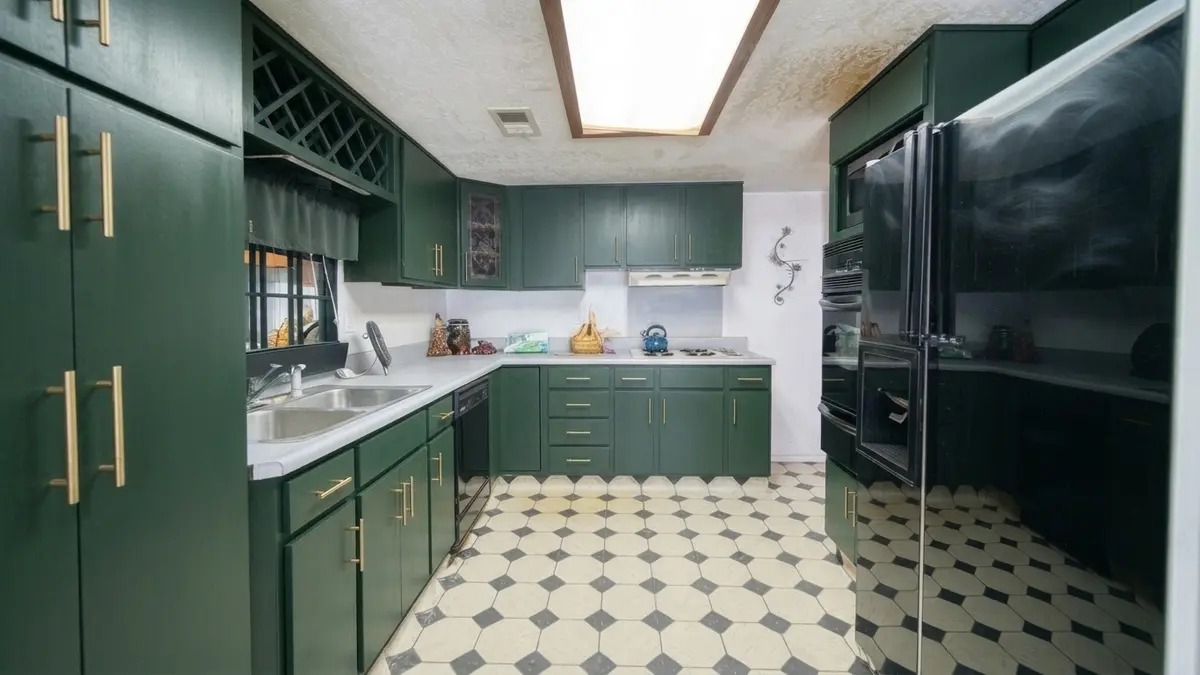
I took one dated kitchen and ran it three ways with the app: solid white uppers as photographed, glass uppers on white, and glass uppers on sage green. The room is an L with a peninsula, a white painted brick fireplace in the living area, cream base cabinets, white tile countertops and a gray and cream checkerboard floor.
What happens when every upper door goes glass?
In the original photo the uppers are solid white, so the wall above the tile reads as one white block. Three doors hang over the peninsula, above a window. Along the back wall there is a narrow cabinet to the left of the over-the-range microwave, three doors above it and two tall cabinets to the right, with a few small open cubbies beside the microwave.
The photo at the top is that kitchen after one step: Door style set to Glass uppers. Every upper door, over the peninsula and along the back wall, became a framed clear-glass door. The cabinets stayed white, and the base cabinets, countertop, backsplash, floor and appliances did not change.
The wall does feel lighter. Where the white block was, you now see layers: frames, shelves, the tile behind. It also stops being quiet. That is the trade, and the next section is where it gets decided.
What should you put in glass front cabinets?
Here is the part I did not expect. With the same setting, the app handled the insides differently on two designs. On the white cabinets it filled the shelves itself: stemmed glasses, mugs, stacked bowls and plates, drinking glasses, a wooden bowl and a few jars and bottles. On the sage version it left the shelves empty.
The empty sage version reads calmer to me: pale shelves framed in green. The stocked white version is busier, and it is also the more honest picture of a real kitchen, because real shelves are never empty. Glass shows what you own, so the useful question is not "do I like glass?" but "would I like looking at my own dishes every day?"
If the answer is matching glasses, white plates and a few mugs, glass works. If it is mismatched cups, boxes of cereal and a stack of takeout lids, you are signing up to arrange that wall, or to put the clutter somewhere else. One way to keep it calm is to keep to one or two colors on display, so the shelves look chosen rather than filled.
Does the frame color matter?
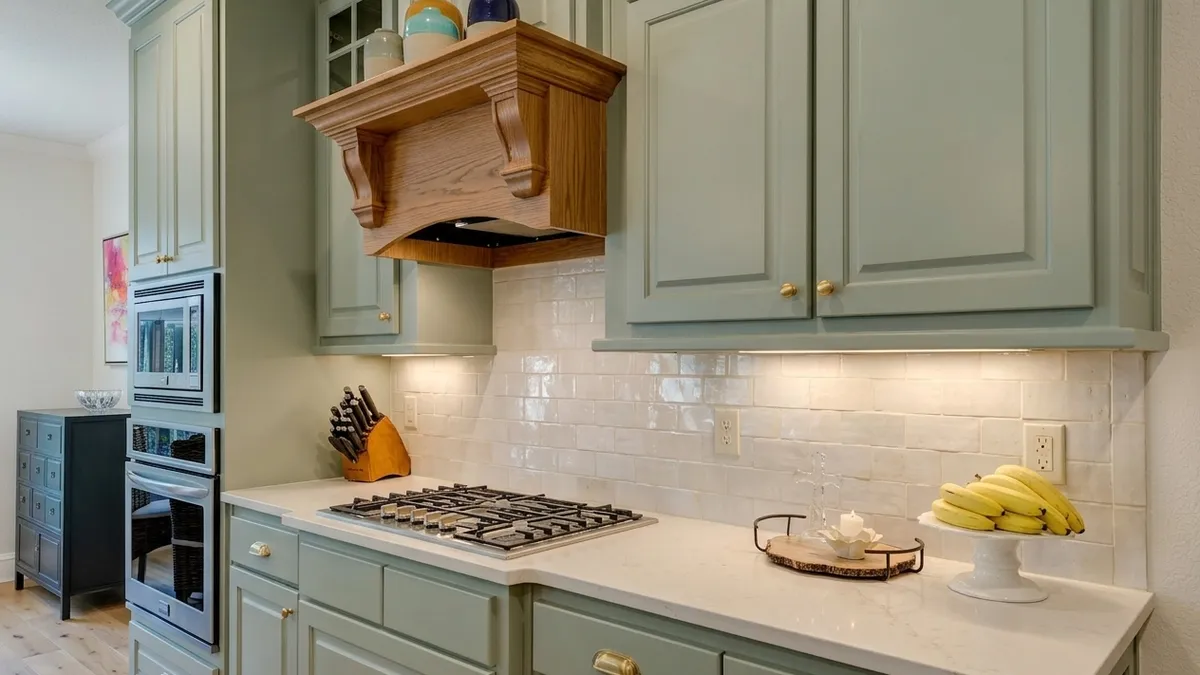
More than I thought. On white cabinets the frames almost disappear against the white tile and wall, so you mostly see the contents. On sage the colored frames outline each glass panel, and the doors read as a deliberate grid. Our guide to sage green kitchen cabinets covers which sage suits which light and what goes with it.
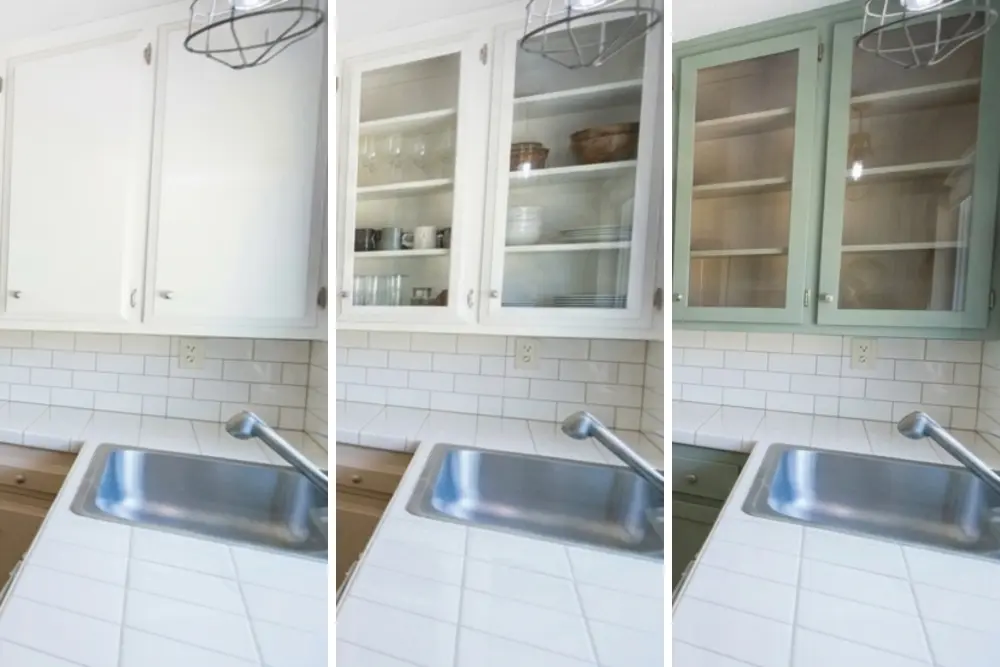
Look at the middle crop. The white frame is thin and light, and the glass is the main event. In the last crop the frame is the main event and the glass is a window inside it. The wood-toned interior also warms the glass, where the white one stays cool. Neither is better. They are different jobs: one disappears into the room, the other draws it.
How many glass cabinets does a kitchen need?
Not all of them, necessarily. The app turns every upper door to glass, including the narrow one beside the microwave. It can't pick which doors. You don't have to glaze them all: glass on only a few doors, for example the pair beside a window or the ones at the end of a run, leaves the rest solid, so there is still somewhere to hide the everyday mess.
To judge a "just two glass doors" plan from the full version, cover the other doors in your head and look at what remains. It is an estimate, not a preview. Block Renovation, in a 2025 guide on upper cabinets with glass doors, makes a related point: glass can "break up long stretches of cabinetry". A long run of solid doors is exactly where one or two glass ones help.
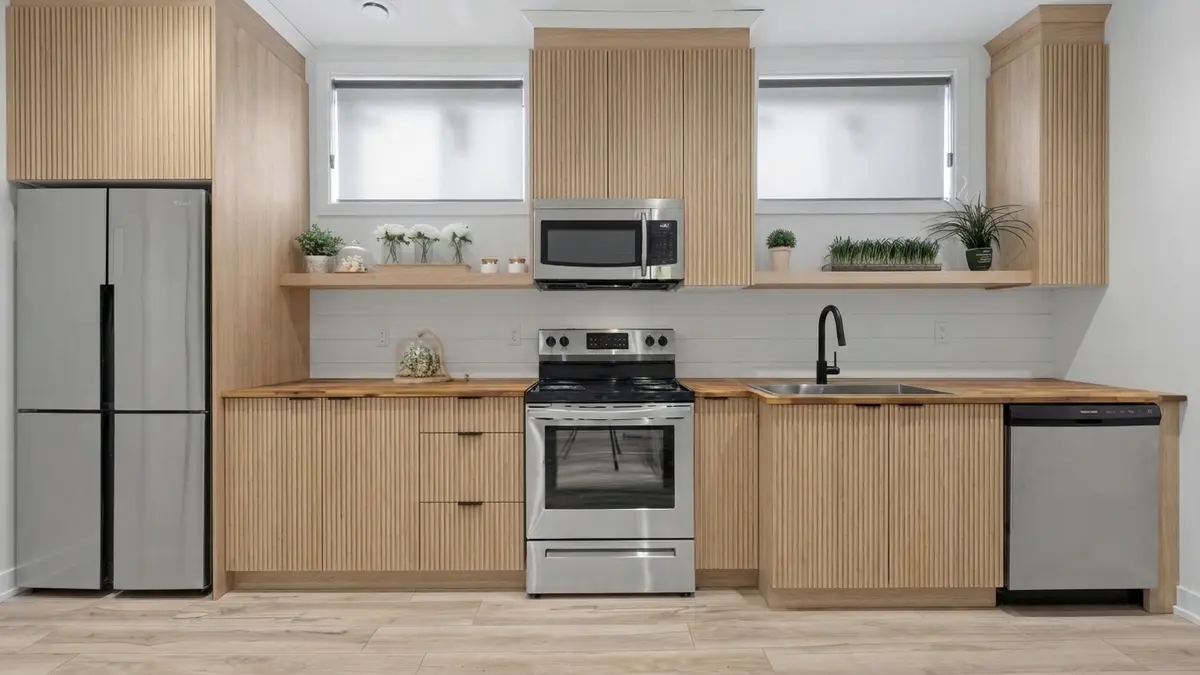
Style matters too. Framed glass is a traditional detail, so it sits comfortably in looks like modern farmhouse, and the kitchen styles hub shows how the other directions handle uppers. If you are still deciding the door itself, shaker vs slab cabinets shows two door styles on one kitchen. And if you want texture on the uppers without showing what is inside, fluted kitchen cabinets put vertical ribs on solid doors.
In a small kitchen, glass is one way to lighten the upper wall without changing the footprint. Paint is the other, and small kitchen cabinet colors covers that side.
What do glass doors cost you?
Mostly in wiping. Block Renovation notes that glass doors need regular wiping, and that frosted, seeded or tinted glass hides smudges better than clear panels. The same guide says clear flat glass "does nothing to semi-obscure the insides", which is the point of it if you want display, and the problem if you don't.
On price, the same source says glass-front cabinets generally cost more than solid fronts, and names what drives it: the materials, the labor to fit the glass panels and specialty glass types. I don't have a dollar figure I can stand behind, so ask a cabinet maker to price the same door both ways.
One more limitation: the app only renders clear glass. There is no frosted, reeded or seeded option, and it doesn't add lights inside the cabinets. If you want textured glass, the render is a stand-in for the framing, not for the glass.
Where the render guessed
Read these images as an impression.
- See-through effects are guesses. Over the peninsula, the glass of the three cabinets seems to show window panes behind it. The photo doesn't show what is behind those cabinets, so that is the model guessing, and a standard cabinet has a solid back. Treat any see-through effect as a guess.
- The shelves are invented. The dishes in the white version are not yours, and the app is not consistent: the sage version got none.
- It's all or nothing. Every upper door changes together.
- No measurements, no price. The layout stays the same, and the app doesn't know what is inside your cabinets.
Four questions before you order glass doors
- Can you picture the shelves with only what you own today, and does it look good?
- Which one or two doors are you really picturing in glass, and is there a window, an end of a run or a long stretch they would break up?
- Do you want the frames to disappear or to outline the doors: white, or a color?
- Do you wipe fingerprints off a door a few times a week without minding it?
If the first and the last get an easy yes, glass is worth trying. Photograph your own kitchen, set Door style to Glass uppers, and add a cabinet color if you are unsure about the frames.
Published November 9, 2026. The images in this article were made with Kitchen AI, and are an AI impression, not a technical drawing. How we mark that.
I build Kitchen AI on my own: the app that shows your own kitchen in a different style. For these articles I test everything in real rooms, with real photos, and write down what happens. Something wrong, or missing? Let me know.