 Kitchen AI


 Modern
 Scandinavian
 Japandi
 Modern farmhouse
 Industrial
 Quiet luxury
- Renovation decisions
- Cabinet refacing
- Costs
Cabinet Refacing vs. Replacing: How to Decide
Refacing, painting and replacing solve different problems, and the condition of the boxes decides which one you need. Here is a five-point check, 2026 costs with sources, the cases where replacing wins, and what one wall looks like in two sets of fronts.

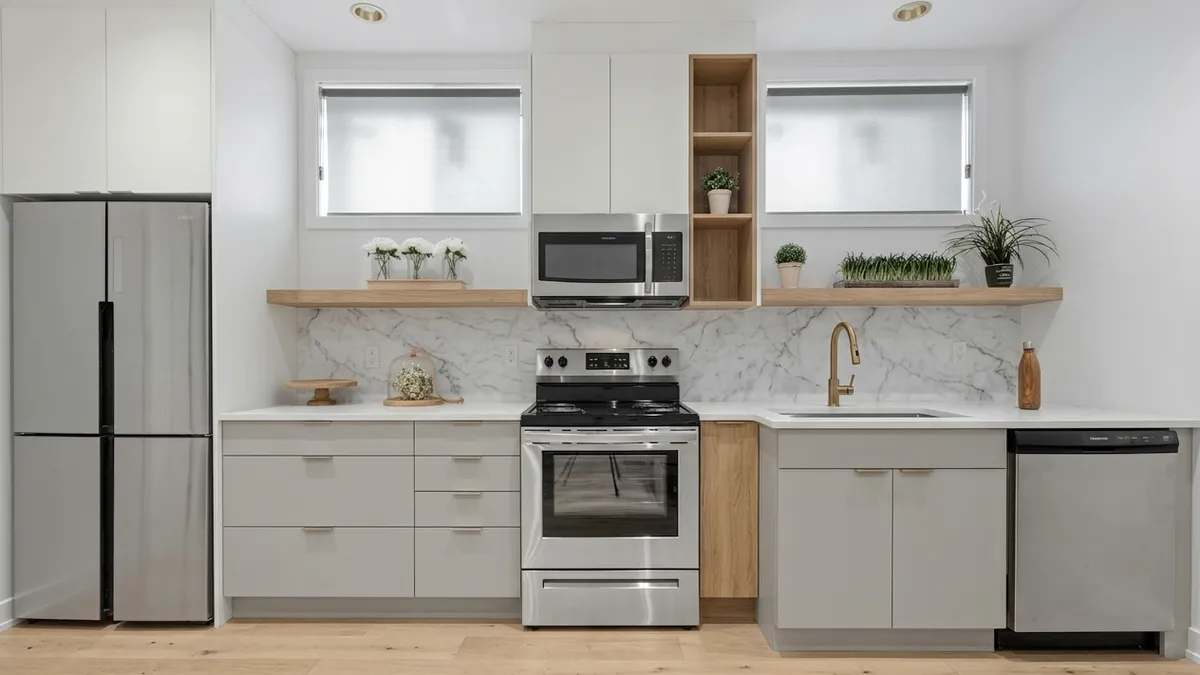
One wall, redone as a Kitchen AI render: flat light gray fronts and a new countertop, backsplash and faucet. Only some of that is what refacing would change; the section on this wall below sorts out which.
Free to try. No account needed.
Reface when your cabinet boxes are solid and the layout stays. Replace when the boxes are swollen, sagging or out of square, or when you're moving the sink, range or fridge. Paint when you like your doors and only want a new color. 2026 cost guides put refacing at about $7,200 and painting at about $4,000; replacing depends on the cabinet grade.
The boxes decide it, not the doors. As Fixr describes the job, refacing replaces the doors, drawer fronts and hardware and puts a new face over the boxes you already own. If the boxes are fine, that covers nearly everything you see and touch. If they aren't, you pay to dress up a problem.
Your boxes are sound if...
Check these with the doors open. This list is my own rule of thumb, not an industry standard, but it follows the cases the cost guides name for when refacing doesn't work: damaged boxes and a changed layout.
- The floor of the sink base is firm. Press on it, and look at the bottom edges of the boxes beside the dishwasher. Soft, swollen or flaking material means moisture got in.
- Shelves lie flat and the boxes sit square. A bowed shelf, or a box pulling away from the wall or its neighbor, is a problem a new face won't fix.
- The frames the doors hang from are intact. Hinge screws that spin in their holes or a cracked face frame leave new doors nothing solid to hold on to.
- Drawers run. Refacing replaces drawer fronts. Whether it also replaces the drawer boxes and slides varies by contractor, so ask. A new front on a sagging drawer still sags.
- You like where everything is. Same sink, range and fridge positions, same number of cabinets, and no missing storage. Fixr notes that refacing can't change the layout or add interior storage.
Miss one of the first three and get a replacement quote before you spend anything on refacing. Miss one of the last two and refacing can still work, but it won't fix what you're unhappy with.
What does cabinet refacing cost compared to painting and replacing?
Every figure here comes from a 2026 cost guide, and the guides don't match exactly.
| Option | What changes | Cost | Watch for |
|---|---|---|---|
| Painting | The color of your current doors | $2,500 to $6,500, average $4,000 (Fixr, 2026) | Door style and layout stay as they are |
| Refacing | Doors, drawer fronts and hardware, plus a new face on the visible boxes | $4,234 to $10,226, most people near $7,230 (HomeAdvisor, 2026); $3,000 to $13,500, average $8,250 (Fixr, 2026); $150 to $450 per linear foot (HomeAdvisor, 2026) | No new layout, no new interior storage |
| Replacing, stock | All new boxes in standard sizes | $100 to $300 per linear foot (HomeAdvisor, 2026) | Standard sizes only |
| Replacing, semi-custom | All new boxes, more sizes and finishes | $150 to $650 per linear foot (HomeAdvisor, 2026) | Ask what the quote includes beyond the boxes |
| Replacing, custom | All new boxes built to your space | $500 to $1,200 per linear foot (HomeAdvisor, 2026) | The only grade that starts above the top of the refacing range |
Two things stand out. First, the usual line that refacing costs 30% to 50% less than replacing (HomeAdvisor, 2026; Bob Vila, 2024) is an average comparison. The per-foot ranges overlap. On the 24-foot kitchen HomeAdvisor uses, $100 to $300 per foot for stock cabinets works out to $2,400 to $7,200, and $150 to $450 per foot for refacing works out to $3,600 to $10,800 (my arithmetic, not theirs). If a refacing quote lands near a stock-cabinet quote, get both in writing.
Second, refacing is quick: HomeAdvisor says a professional crew needs three to five days for a standard kitchen. For replacement, ask for the lead time, since the cabinets have to be ordered first.
Is refacing cabinets worth it?
It is when the boxes are fine, the layout works, the storage is enough, and what you dislike is the door style, the color or the finish. It is not when the boxes are damaged: money spent refacing a bad box is money you spend again on replacement. HomeAdvisor says refacing enhances a home's value, but I found no resale figure specific to it, so don't plan around one.
Refacing vs painting cabinets: which one fits your doors?
Painting changes color and nothing else. The door keeps its shape, its hardware holes and its flaws. Fixr says professionally painted cabinets can last 8 to 10 years with proper care, and that painting is not recommended when the boxes have severe structural or water damage, or when the layout has to change. Those are the same limits as refacing, at a lower price.
So the choice is about the door. Paint if you like its shape. Reface if you want a different shape or material. On the wall discussed below, the original fronts are gray framed Shaker doors, which many people would simply repaint. The render at the top changed them to flat slab, which paint can't do. If your boxes are IKEA SEKTION, a door-only swap is a cheaper cousin of refacing, covered in custom doors for IKEA SEKTION cabinets. If the color is what you can't settle, read white vs. off-white kitchen cabinets before you pick a paint or a veneer.
When is replacing the right call?
The layout changes
Refacing keeps every box where it is. Moving the sink, adding an island or taking out a wall means new boxes anyway, so refacing first is wasted money. If you might change the layout later, settle that first.
Water got into the boxes
Fixr says to avoid refacing when cabinets are structurally unsound or have water or moisture damage. Start with the sink base, because that is where leaks usually end up. If only one box is damaged, ask whether replacing that box and refacing the rest is possible and how well it would match. I haven't priced that combination, so treat it as a question.
The boxes sag, rack or don't work for you
Bob Vila puts it plainly: refacing may not be the best option if the existing cabinets are damaged, don't operate well, or the homeowner needs a better layout. Add the kitchen whose cabinets simply don't hold what you need: a new face doesn't add storage.
What does refacing change? One wall, new fronts
To see how far new fronts alone go, I used one wall from our archive of Kitchen AI renders: a straight run with two windows, a freestanding range left of center, a sink to the right, a dishwasher at the far end and a stainless fridge at the left end. The original photo, which isn't shown here, has gray framed Shaker fronts below, white above, black bar pulls, a butcher-block countertop and a white shiplap backsplash. The cabinets look sound and fairly recent; I picked the wall for its layout, not because anything is worn out. Counting from that photo, the run has 16 fronts: seven drawers, three lower doors, one false drawer panel above the sink base and five upper doors across three upper cabinets. A refacing quote covers all 16, plus the visible faces of the boxes.
The render at the top of this page is that wall. The fronts changed on purpose: framed Shaker became flat slab, and gray and white became a light gray. But the render also changed things a refacing job leaves alone. The countertop is white, the backsplash is marble-look, the faucet is brass-toned, the ceiling fixtures differ, and an open oak shelf unit replaced the narrow upper door beside the microwave. That last change is carpentry, not refacing. The windows, range, sink, dishwasher and fridge have not moved, which is the point of refacing.
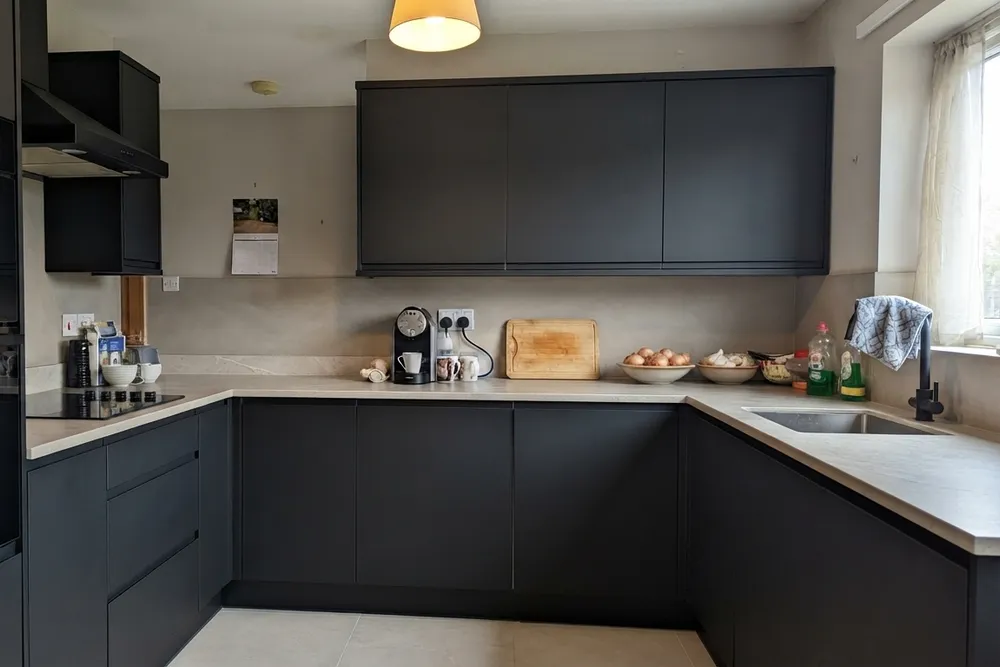
It shows the same pattern at its most extreme. The fronts did change from white gloss to matte black, and the handles are gone. But the original tiles and countertop did not stay: the render replaced the white metro tiles with a full-height backsplash in the same pale stone-look as the new countertop, swapped the floor tiles, turned the steel ovens and hood black, and swapped the double sink and chrome tap for a single sink and a black tap. A radiator on the back wall in the original photo is also missing from the render. A refacing job would change the fronts and leave all of that in place. I compared each original photo with its render, element by element, and in both the new surfaces carry as much of the change as the fronts do. Our before and after page says the same about its examples: most variants move at least three of the four elements at once. If you only reface, expect a quieter result than the render, unless you buy the countertop and backsplash separately. Flat, handleless fronts like these sit in the modern kitchen style.
What a render can't tell you
A render shows a door style and a color on your wall. It can't see inside the boxes. A photo of a kitchen with a soft sink base looks like one with a firm sink base, and so do their renders. That is why the box check comes first.
It also can't tell you whether your boxes are square or whether new doors will hang right on them. It can't show a specific contractor's door: "flat slab" in a render is an interpretation, not a product, so check a real sample. It doesn't move the layout, and it gives no price or quote. And because the app regenerates the whole photo, it can change things you didn't ask about, as with the open shelf above. Our piece on apps that show new cabinets has three more examples. Treat a result as an impression of a direction, then confirm it with samples and a quote.
What to ask before you sign a quote
- What exactly is replaced: doors, drawer fronts, drawer boxes, hinges, slides, hardware and the veneer on the box faces?
- Will you look at the sink base, and any box with staining, before you price the job?
- What would replacing the same kitchen cost, and what does that quote include: demolition, taking the countertop off and putting it back, and the plumbing and electrical reconnection?
- How many days will the kitchen be out of use? HomeAdvisor's figure for refacing is three to five.
Before those calls, photograph your kitchen in daylight and try two or three fronts on it. If you're torn between a color or a door style, you can see it on your own wall in five minutes. With a direction chosen, you can ask each contractor for the same thing. The app is free to try, needs no account and runs on iPhone.
Published October 6, 2026. The images in this article were made with Kitchen AI and are an AI impression, not a technical drawing. How we mark that.
I build Kitchen AI on my own: the app that shows your own kitchen in a different style. For these articles I test everything in real rooms, with real photos, and write down what happens. Something wrong, or missing? Let me know.