 Kitchen AI


 Modern
 Scandinavian
 Japandi
 Modern farmhouse
 Industrial
 Quiet luxury
- Warm modern
- Lighting
- Wood tones
Warm Modern Kitchen: Six Fixes for a Cold One
A modern kitchen feels cold for a few fixable reasons: a cool white, a gray undertone, bright light and surfaces that only reflect. Here are six settings to turn, and the point where each one goes wrong.

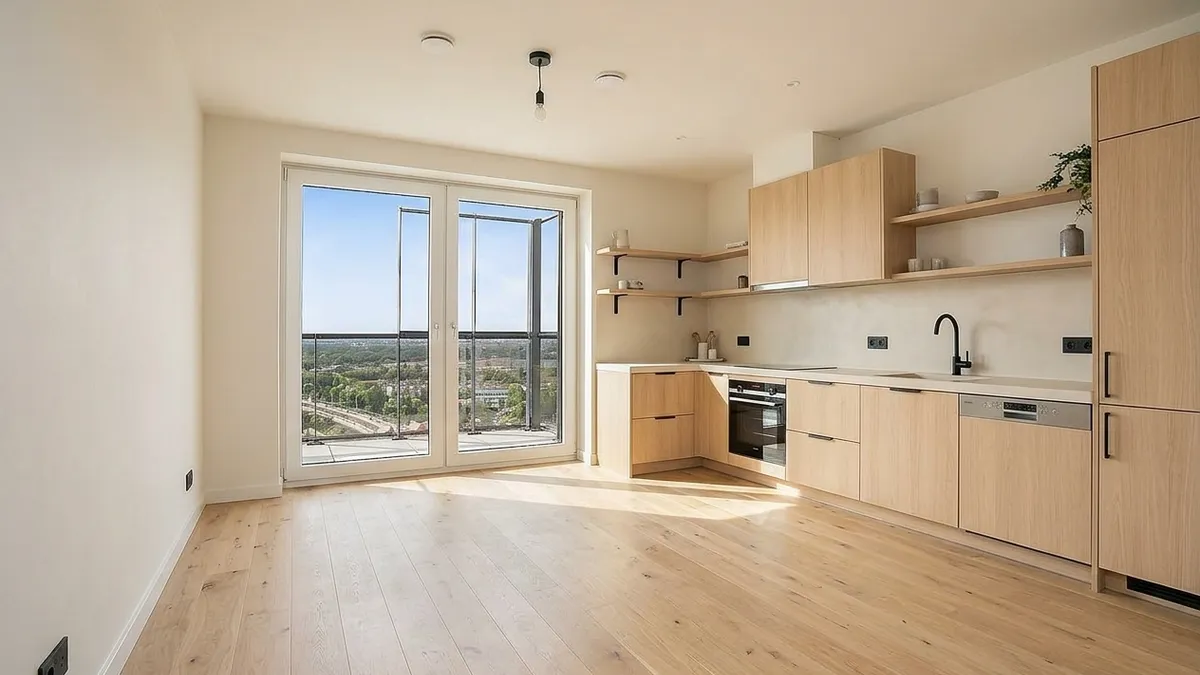
The hero room: oak fronts, oak shelves and an oak floor in one pale range, cream walls, and four open shelves. The ceiling still has a bare bulb on a cord.
3 free designs. No account needed.
A modern kitchen feels cold because of cool white light, gray undertones and surfaces that only reflect. To warm it, match one wood tone to the floor, choose a cream-leaning white, light it at 2,700 to 3,000 K, keep counters honed, add one run of open shelving, and bring in textiles. Each fix works until you overdo it.
What makes a modern kitchen modern has its own page, and so do the wood-heavy Japandi and stone-heavy quiet luxury routes. This article is for a different situation: you have, or are about to order, a sleek kitchen and it feels like a showroom. The same six settings also build a warm minimalist kitchen from scratch. They are in the order I would turn them, each with the point where it stops helping.
Every image here is the same empty new-build room: one balcony door, a straight run of cabinets, a ceiling with bare cords and one bare bulb where the lamps will go. I put three versions of it side by side and looked for what made each one feel warm or cold. They are AI impressions made with Kitchen AI, so read them for how materials sit next to each other, not for exact color.
1. Tie the wood tone to the floor
A modern kitchen with wood is warm only when the wood agrees with itself. The floor is the biggest piece of wood in the room, so start there: choose cabinet and shelf wood within a shade or two of it, and the room reads as one material instead of three. Judge the undertone on a sample in daylight, not by the name on the tag. In the hero image the oak fronts, oak shelves and oak floor all sit in the same pale golden range, and that is most of why the room feels easy. Cabinet colors with oak floors shows how undertone behaves when the cabinets are not wood.
Overdo it and you have too many woods: a third species on the stools, a fourth on the table, and the warmth turns into a sample board. I stop at two.
2. Choose a white with some cream in it
Cool white walls next to cool white fronts are the fastest route to a modern kitchen that feels too cold, and the fix is cheap: step the white toward cream. In the hero the walls are a soft cream and the room stays calm without any added color. For cabinets, off-white versus white cabinets explains how to read the undertone from a paint's light reflectance value. Test the white next to your appliances and sink as well, because they keep their own tone and show the difference.
Overdo it and the cream turns yellow. Against bright white appliances, a white that leans too far looks aged rather than warm.
3. Light it at 2,700 to 3,000 K
Light color is the cheapest knob in the room, because you swap a bulb instead of a door. The U.S. Department of Energy's Federal Energy Management Program, on its light bulb purchasing page (modified September 2026), lists 2,700 K as warm and 3,000 K as soft, both for homes, and 4,100 K as cool, which it places in offices, classrooms and showrooms. Showroom light on a showroom kitchen is exactly the effect you are trying to undo.
Check the CRI on the box as well. The same page says ENERGY STAR-qualified bulbs must reach a CRI of 80 or greater, and that a higher value means a better light source. Between two bulbs at the same Kelvin, take the higher CRI, since wood is the material that shows the difference. For evenings, the DOE's guide to color-tunable LEDs (2022) describes dim-to-warm products that start at 2,700 to 3,000 K and fall as low as 1,800 K, the color of candlelight, as they dim.
In the first image of the comparison below, the strip under the open shelf glows warmer than the balcony daylight. It is the only place in these renders where lighting does visible work, and it does a lot. Overdo it and you get yellow light: pushing the whole kitchen to the low end, or mixing 2,700 K under the cabinets with 4,100 K pendants, turns the oak orange and the white counters dingy.
4. Keep the countertop honed, not mirror-polished
The style pages already say to ask for honed. The reason is worth adding. A polished top reflects whatever faces it, so in a room with a big window it shows you the window, while a honed or matte top shows its own color, and its color is what you chose. Ask your fabricator for a sample in each finish and look at both from the height and angle where you will stand, not flat on a table.
Overdo it and a dead-flat, mid-gray counter beside a gray floor, as in the second comparison image, stops reading as a surface and starts reading as more floor.
5. Add one run of open shelving
Open shelves bring in the warm things you own: wood, glazed ceramic, books. The hero has four short oak shelves, two in the corner on black brackets and two along the right wall, and they carry the wood of the fronts up onto the wall without another run of cabinets. Keep it to one run and put a few matte or grained objects on it, rather than a full set of anything.
Overdo it and shelves on every wall, filled to the edge, make the kitchen look busy. The clutter you hid behind doors is now the style.
6. Bring in a few soft things
A modern kitchen is hard surfaces from floor to ceiling. A linen runner, woven or wooden stools and a cotton towel give the eye something that does not reflect. None of this appears in the empty-room renders, and that is the point: it is the last fix, and the cheapest to try and to undo.
Overdo it and a patterned rug, curtains and three kinds of towel turn it into a different style. The clean lines that made you choose modern are the first thing to go.
Same room, two designs: which one is warmer?
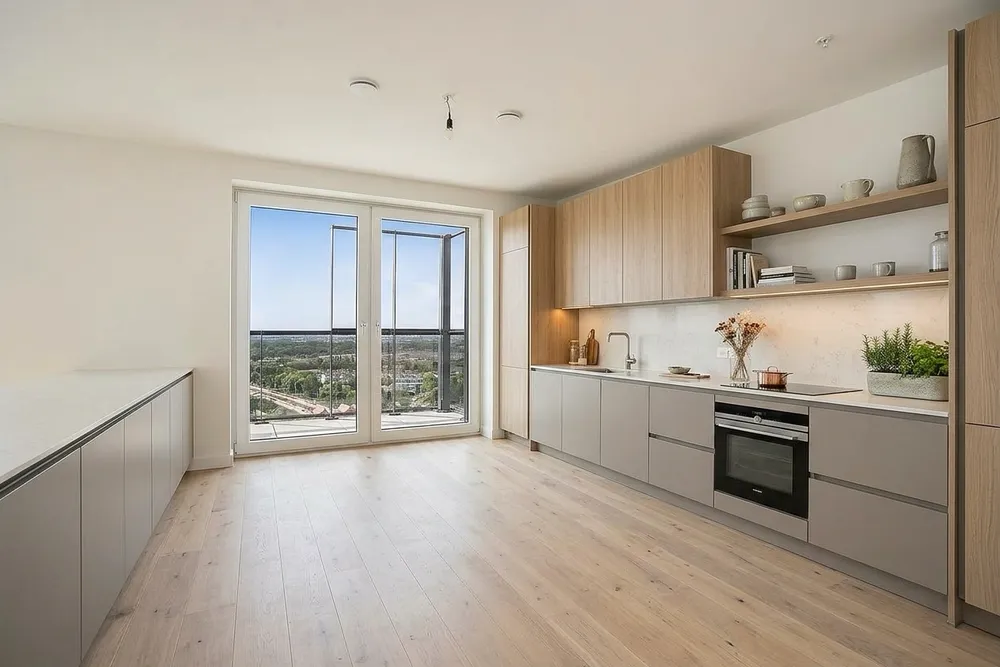
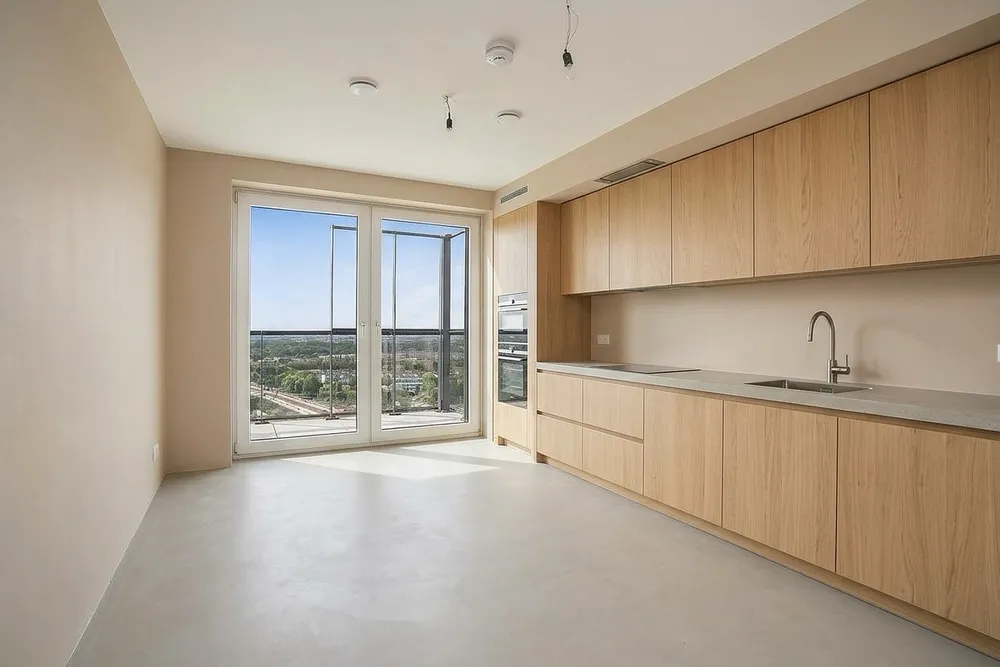
The first design has greige handleless lower cabinets, oak upper cabinets and tall units, a pale speckled stone counter and backsplash, a whitewashed oak floor, and ceramics, books and a strip of light along an open shelf. The second has flat oak fronts on both runs, a gray concrete-look counter and floor, sand-colored walls and backsplash, and nothing on display.
To my eye the first reads warmer, even though the second has far more oak. The wood floor and the lit shelf warm the whole room, while in the second the gray floor and counter take back what the oak gave. The sand walls are doing real work there, the warmest wall color of the three renders, but they cannot carry a room with a cool floor. More wood did not mean warmer. What the wood sits next to mattered more.
This pair is not a controlled test. It differs in cabinets, floor, counter, wall color and styling at once, and the objects on the first image's shelves do part of the work. For a clean answer on your own kitchen, change one thing at a time.
What the app can't do
Kitchen AI changes eight elements: cabinets, door style, countertop, backsplash, faucet, flooring, wall color and hardware. That covers fixes 1, 2 and 4: wood tone, white and countertop finish. It does not change your bulbs, add shelves or place textiles, so the Kelvin in fix 3 you test with a real bulb in the real room, in the evening. Every result is an AI impression, not a drawing or a sample, so confirm wood and paint on a physical sample in your own light before you order.
Test the two the photo can show
Wood tone and white are the two fixes a photo can answer. Upload your kitchen, change the cabinets and the wall color, leave the floor as it is, and compare the versions side by side. Then buy one 2,700 K bulb, put it in the lamp you use most, and judge the rest after dark.
Published October 9, 2026. The images in this article were made with Kitchen AI and are an AI impression, not a technical drawing. How we mark that. Color temperature and CRI figures: U.S. Department of Energy, linked above.
I build Kitchen AI on my own: the app that shows your own kitchen in a different style. For these articles I test everything in real rooms, with real photos, and write down what happens. Something wrong, or missing? Let me know.