 Kitchen AI


 Modern
 Scandinavian
 Japandi
 Modern farmhouse
 Industrial
 Quiet luxury
- Trend watch
- Wood cabinets
- See it first
Are Wood Kitchen Cabinets Back in Style?
Wood is now the most popular cabinet finish among people who are renovating, but the wood being chosen is narrow: pale to medium, straight-grained and matte. Here is which woods are in, which tone still dates a kitchen, and one open kitchen shown in three cabinet finishes.

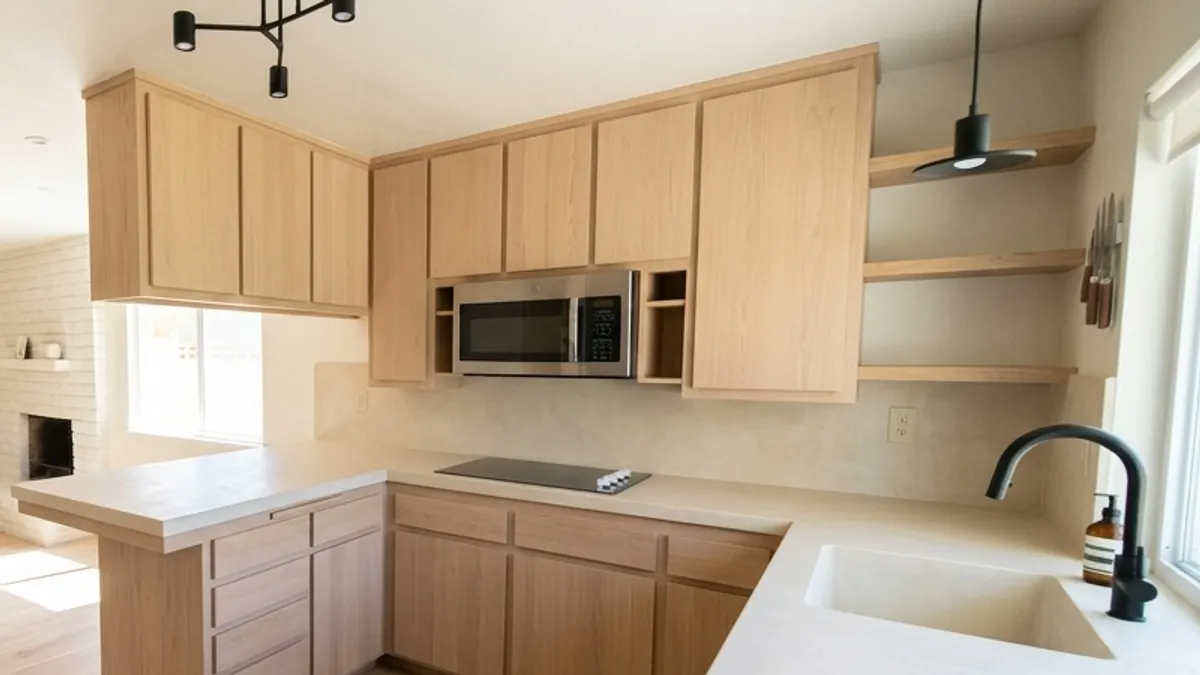
The light wood design, the first of three finishes we ran through the same kitchen further down. Cabinets, shelves, countertop and backsplash all sit in one narrow band of light tan and cream.
Free to try. No account needed.
Yes. In the Houzz 2026 Kitchen Trends Study, wood-tone cabinets were the most popular choice among renovating homeowners at 29%, one point ahead of white at 28%. The wood in demand is pale to medium and straight-grained, and white oak is the species professionals cite most. The orange honey oak of the 1990s is the version that still reads dated.
What the 2026 numbers say, and what they don't
The Houzz 2026 Kitchen Trends Study surveyed 1,780 U.S. Houzz users who were at some stage of a kitchen renovation. It was fielded in July 2025 and published on January 29, 2026. Wood-tone cabinets came in at 29%, up six points on the year before, against 28% for white-painted cabinets. Inside that wood share, medium tones account for 15 points, light wood for 11 and dark wood for 3.
The second source is the NKBA's 2026 Kitchen & Bath Design Trends report, as reported by Apartment Therapy in September 2025. It surveyed designers, remodelers, showroom professionals and contractors. In it, 59% named wood cabinets a popular trend and 51% said white oak is the preferred cabinet material among people currently renovating.
Two caveats. A one-point lead over white means wood has caught up with white and nudged past it, not that white is finished. And both surveys describe projects from 2025. No 2027 study exists yet, so "wood cabinets in 2027" is a direction, not a number. If you want the white side of the same Houzz data, we covered it in are off-white cabinets still in style.
White oak, and why rift-sawn keeps coming up
White oak is the species behind most of the pale, quiet wood kitchens: a light tan with little orange in it. The 51% above is a professional vote, not a homeowner survey, but the Japandi and Scandinavian looks both lean on it, and our Japandi kitchen guide describes wide-plank white oak against plastered walls.
Pairs with: plaster-look or cream surfaces, black fixtures and matte stone. A kitchen cabinet company's 2026 trend post suggests light white oak with natural stone countertops.
Watch out: "white oak" on a quote does not say how the board was cut. The same post describes rift-cut oak as having a straight, consistent grain without the arched "cathedral" pattern of plain-sawn boards. On large flat doors that difference is most of the look, so ask which one the price assumes and ask to see a full door.
Walnut: dramatic, and a smaller share
Walnut is the dark end of the trend. Houzz counts dark wood at 3%, the smallest of its three tone groups, so this is a minority taste even in a wood-heavy year. The same company's post describes walnut's chocolate tones and flowing grain and says it is often used as a focal point on an island, a range hood or accent cabinetry rather than on every door.
Pairs with: painted cabinets. That post suggests warm walnut with painted cabinetry, and it also lists navy, deep green and clay as companions for wood.
Watch out: dark surfaces take in light, which is the same logic as in are black kitchen cabinets too dark. A kitchen with one window can carry walnut on an island or a hood, and gets heavy fast with walnut on every door.
Medium and honey tones: where the trend stops
Medium tones lead the Houzz breakdown at 15 points, so medium is not the problem. The orange end of it is. Andrea DeRosa, co-founder of Avenue Interior Design, said in Martha Stewart Living in September 2025 that honey oak "reads as builder-grade rather than custom," and recommended natural white oak because it "keeps the warmth you love, but in a lighter, more neutral tone."
Pairs with: a clearly lighter wall and a countertop with real contrast, so the wood has an edge.
Watch out: an orange undertone, which a small sample can hide. Look at a full door in the room's own light before you choose a "medium" tone.
Same room, three cabinet finishes
We took one photo of an open U-shaped kitchen and ran it through three designs in Kitchen AI: light wood slab doors (the design at the top of this page), painted sage shaker doors, and matte black with oak accents. The layout is identical in all three: the peninsula, the window on the right wall, the painted brick fireplace behind it and the microwave in the upper run. The floor, wall color, countertop, backsplash and lights changed along with the cabinets, so this is not a one-variable test. Read it as three complete looks, not three paint swatches. The light wood design is the hero photo above, with a cream plaster-look countertop and backsplash close to the wood in tone and a pale plank floor.
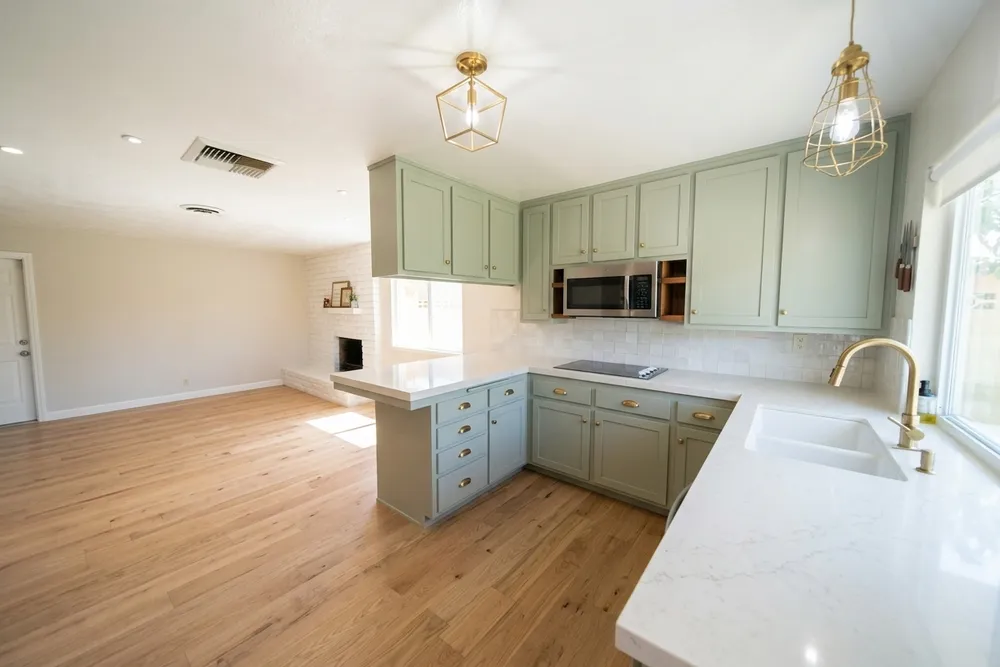
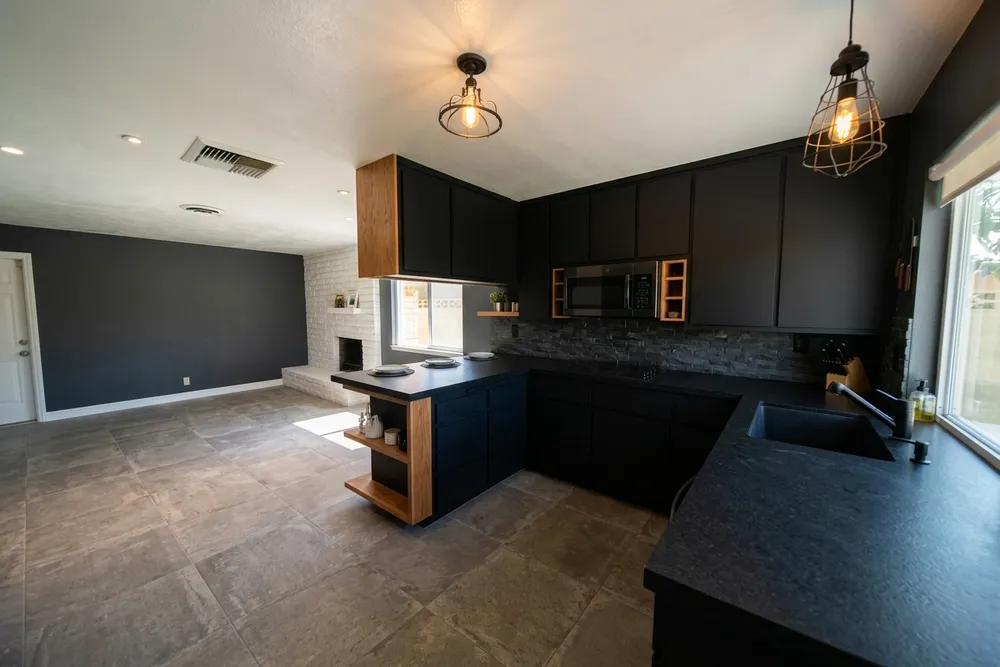
Three things stood out when we compared them. First, in the wood design nothing has a hard edge: doors, countertop and floor sit in one band of tan and cream, and only the black faucet and lights break it. That is calm, and it can also read flat. Second, in the painted design the color lives on the doors and the wood moves to the floor, while the white quartz and white tile give the green a crisp edge. Third, in the black design wood shrinks to a handful of oak pieces, and those few read as warm highlights. That is the lowest-commitment way to get wood into a kitchen.
Wood also differs from paint in one way you can see even in the render: in the light wood design at the top the doors vary slightly from one to the next in tone and grain. Real wood does that too. Some people love it and some count it as a flaw, which is another reason to look at a full door and not a small sample.
Pairing wood: countertops, hardware, floor
Light wood with white countertops. We did not render light wood against a white countertop in this room: our wood design uses a cream surface. What the three designs do show is the difference between the two choices. A white countertop, like the quartz in the sage design, draws a clear line between cabinet and counter. A cream one, like the light wood design, lets them merge into one warm field. Choose on purpose: white if you want the wood to read as furniture, cream if you want a continuous room. Check it on your own photo, because a white countertop in a bright kitchen reads very differently from the same one in a dim one.
Hardware. Black fixtures sit in both the light wood and the black designs, and brass sits in the sage one. In the light wood design the black faucet and pendants are the only dark notes, and they give the pale wood something to push against.
Floor. Wood cabinets over a wood floor is the pairing people worry about most. We ran light oak cabinets over a light oak floor in kitchen cabinet colors that work with oak floors. Our Scandinavian kitchen guide covers the white-cabinet, light-oak version of the same palette.
When wood is the wrong call
Trend is your only reason. A one-point lead is not a mandate. A painted kitchen you actually like will date more slowly than a wood kitchen you chose reluctantly.
The room has little light. Pale wood is the safer choice in a dim kitchen. Medium and dark wood take in more light, so a one-window kitchen is where to be most cautious.
The floor is already a strong wood tone. Two warm, similar woods can compete. If you can't change the floor, a painted cabinet or a clearly lighter wood gives you the contrast.
What the app can't do
The wood in these designs is an impression of wood, not an oak sample. The app doesn't tell you the species or the cut, it gives no stain code or price, and the grain you see isn't the grain a given cabinet door will have. It also doesn't move the peninsula, the window or anything else in the layout. Get a full-size door sample and look at it in your own light before you order.
Try the wood on your own photo
Light wood, painted or wood as an accent: you can see which one your own room wants in about five minutes, instead of in your head. Photograph the kitchen, change the cabinets, and keep the floor and countertop you already have to see what actually changes. For more rooms in other finishes, the before and after gallery has full sets.
Published October 7, 2026. The images in this article were made with Kitchen AI and are an AI impression, not a technical drawing. How we mark that.
I build Kitchen AI on my own: the app that shows your own kitchen in a different style. For these articles I test everything in real rooms, with real photos, and write down what happens. Something wrong, or missing? Let me know.