 Kitchen AI


 Modern
 Scandinavian
 Japandi
 Modern farmhouse
 Industrial
 Quiet luxury
- Renovation decisions
- Oak cabinets
- See it first
How to Update Oak Kitchen Cabinets, Depending on How Much You Keep
Honey oak cabinets can stay, be restained, be painted or be replaced as a look. Which one fits depends on how sound the boxes are and how much of the oak you want to keep. We ran one dated oak kitchen through a full redesign to show the far end of that range.

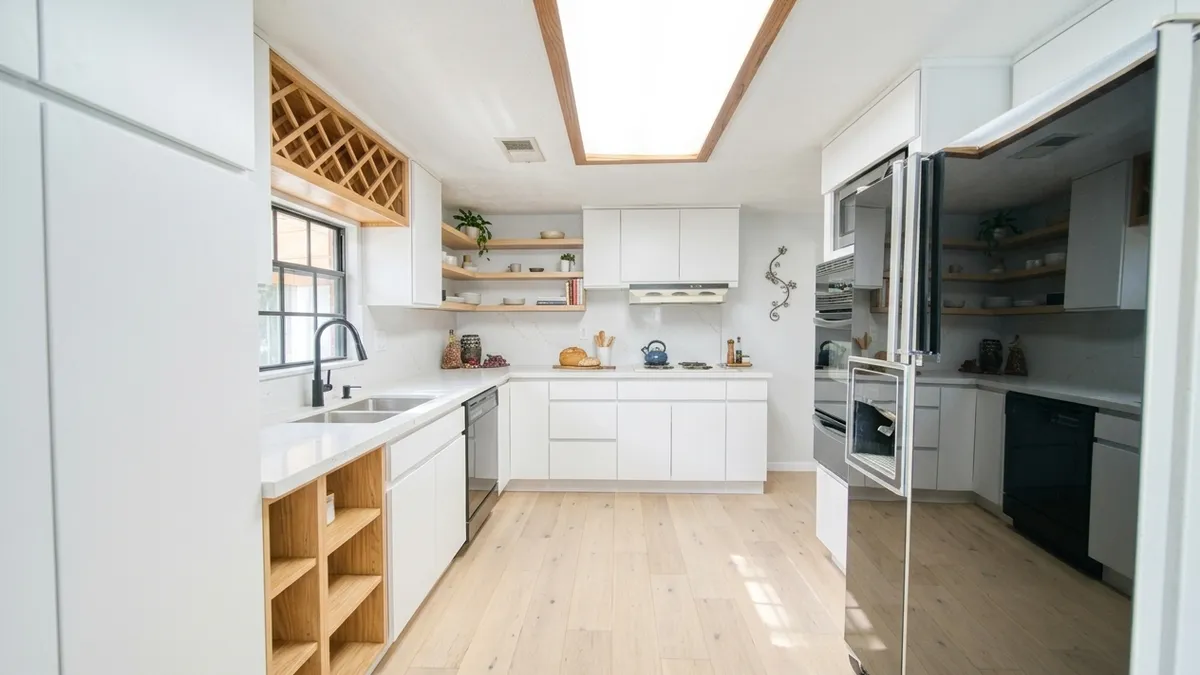
The same honey-oak U-shaped kitchen after a full look change in Kitchen AI: flat white fronts, light counters, pale plank floor. The oak that remains is the wine rack, the open shelves and the frame around the skylight.
Free to try. No account needed.
Decide how much of the oak stays. If the boxes and doors are in good shape, change what surrounds them first: countertop, backsplash, hardware, lighting and wall color. If the orange tone is the problem, restain or paint. If the door style is the problem, replace the doors and keep the boxes. If it is the honey tone rather than the wood itself that bothers you, it helps to know that wood cabinets are back in style: pale white oak leads that return, the orange end of the range does not. For what each of those moves costs on its own, from paint to new doors to under-cabinet lights, see kitchen makeover on a budget.
Everything here uses one kitchen: a dated honey-oak U-shape with raised-panel doors, a wine rack over the sink run with two upper cabinets with leaded glass beside it, one window over the sink, a skylight box in the ceiling and a checkerboard vinyl floor. It's the same room as in our piece on cabinet colors that work with oak floors, which looked at the floor. This one is about the cabinets, and about which of your options leave the oak alone.
Keep all of it: change what surrounds the oak
Oak itself isn't what dates a kitchen like this one. The pile-up is: an orange-brown finish, raised panels, brass pulls, a pale gray counter and a busy floor, all in one view. Change the supporting cast and the oak often reads differently without being touched, which is also the only route that costs you nothing you can't undo.
Countertop. This is the biggest surface next to the doors, so it does the most. Honey oak carries a lot of orange, so my default is a counter that doesn't add a second warm mass: white, or a quiet gray. A beige or tan speckled counter beside honey oak tends to compete instead of contrast, the same warm-on-warm problem that honey-oak floors have (we cover that in the oak floors article). That's my judgment, not a rule, and it shifts if your oak is browner than orange. The render in this article replaces the oak doors, so I can't show you this one; you can test it on your own photo.
Backsplash and walls. Keep the backsplash plain and the walls lighter and cleaner than the oak. Oak grain is already a pattern, and a busy backsplash on top of it gives you two.
Hardware and light. Brass pulls on raised-panel doors say "original." Plain black or brushed nickel bar pulls change that quickly and cost little to try. Light under the upper cabinets is worth trying too.
In the app, countertop, backsplash, hardware and wall color are separate choices, so you can change only those. Then compare the doors before and after: in our test of how these apps behave, the result sometimes changed things we hadn't asked for, including door panels.
Keep the boxes: restain, paint or reface
Restain. Bob Vila's guide says that unless cabinets are raw wood, the existing finish has to come off before new stain goes on (2020). Honey oak is already a mid-tone and stain adds color, so in practice you go darker: a deeper brown, not a lighter one. It's the route for someone whose complaint is the orange, not the grain.
Paint, or not? Paint if color is your complaint, the boxes are sound, and you can accept two things. The grain shows through unless you deal with it, and in practice painting is permanent. Bob Vila notes that oak's "open grain can show through the finish unless it's filled or sealed first" (updated May 2025). Filling means pressing grain filler in, letting it dry and sanding it back. One DIY write-up used DAP Premium Wood Filler and sanded with 120 then 220 grit (Woodshop Diaries, 2021). Another, using Timbermate on oak doors, found it "doesn't make the grain go away completely" on heavy grain but "does minimize considerably," at about 30 minutes of drying per door in front of a fan (Addicted 2 Decorating, 2016).
Oak also contains tannins that can show through light paint. General Finishes sells a water-based stain blocker for exactly that and lists oak among the woods it's for (Woodcraft product page). On a previously finished cabinet, Bob Vila's advice is a bonding primer as the first coat. If you're going white, choose the white against your own light before you buy the gallon; the white versus off-white comparison shows how different two near-whites look on cabinets.
When not to paint: if you like the grain, or if the finish is sound and new pulls plus a new counter get you most of the way. I'd also hold off if you'd be unhappy with a slightly textured door, because no amount of filling makes oak glass-smooth.
Reface. Refacing replaces the doors and drawer fronts and puts new veneer on the frames, and it makes sense when the interiors are in good shape and you like the layout (This Old House, updated June 2026). It's the answer when both the finish and the door style bother you. For what a door swap changes on an existing box, see our piece on custom doors for IKEA SEKTION cabinets. Whether refacing beats new cabinets altogether, and when the boxes are no longer worth keeping, is the question in cabinet refacing vs. replacing.
Replace the look: new doors, new surfaces
This is where the render at the top sits. I started from one photo of the kitchen and had Kitchen AI redo it with flat white fronts, light counters and a pale plank floor. It shows the far end of "how much oak do you keep," and it does not show painted oak doors. It's one render, so treat it as one possible look, not a verdict.
What I notice. The layout, the window over the sink and the skylight stay put. The raised-panel doors became flat slabs, the brass pulls are gone (no visible hardware), and the two leaded-glass uppers beside the wine rack came back as plain doors. The oak that survives is lighter and more natural than the original orange-brown: the wine rack, the open shelving and the frame around the skylight. Counter, backsplash and floor changed at the same time as the fronts, so the image can't tell you which change matters most.
That matters for your decision. The oak was not the problem in this render; the orange finish and the raised-panel doors were. If your kitchen has good boxes, that's the argument for keeping them and changing the doors, not starting over. Our Scandinavian kitchen page covers the style this version leans toward.
I'm leaving dollar figures out. Quotes vary with kitchen size, region and door style, and I'd rather you get itemized numbers than rely on a number from me. Ask each contractor which of the three routes they're pricing.
Which route fits
| Route | What changes | The catch | Easy to undo? |
|---|---|---|---|
| Change what surrounds the oak | Counter, backsplash, hardware, light, walls | The orange finish and door style stay | Yes |
| Restain | Color of the wood, grain stays visible | Finish must come off first; realistically darker | No |
| Paint | Color of everything | Grain shows unless filled; tannin can bleed through | No, in practice |
| Reface or new doors | Door style and finish | Boxes must be in good shape | No |
| Replace the look | Doors, surfaces, often floor | Biggest scope; a render shows a look, not a plan | No |
What the app can't do
It can't tell you whether your boxes are sound; that needs hands and a flashlight. It doesn't show grain texture, so a render of white cabinets looks smooth even when your painted oak wouldn't, and for that you paint the back of one door. It can change the door style when you only meant the color, as it did here. And it doesn't produce a price quote, a measured drawing or a specific manufacturer's finish. The result is an AI impression.
Where to start
Start with the cheapest step you can undo. Photograph the kitchen in daylight with the lights off, try a new counter, backsplash and hardware on the oak as it is, and see whether the room still bothers you. If it does, a render can help you see which of the other routes you're actually after.
Published October 5, 2026. The images in this article were made with Kitchen AI and are an AI impression, not a technical drawing. How we mark that.
I build Kitchen AI on my own: the app that shows your own kitchen in a different style. For these articles I test everything in real rooms, with real photos, and write down what happens. Something wrong, or missing? Let me know.